
Developing a load for your Remington 700 ML/MLS muzzle loader (originally posted to our old website on 11/26/2015) reposted and edited. A lot of this applies to the Ruger 77-50 but this post was written before we started supporting that rifle too.
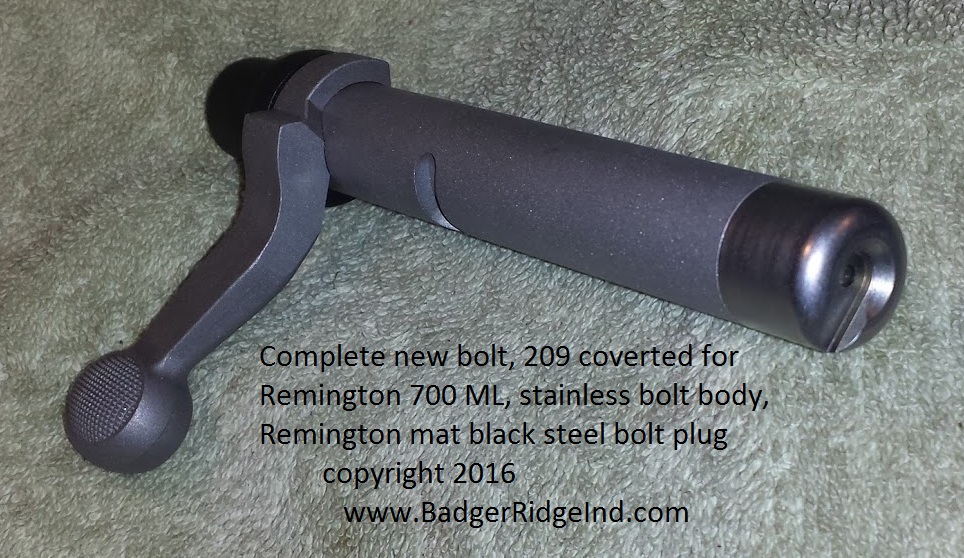
I often am asked what loads I recommend for Remington 700 ML’s with our 209 conversion kit. When I compose my reply I try to stick to generalities, because it doesn’t matter much what I like, but what shoots well. And you can’t know that without some serious range time. Thus I like what makes sense to me and my rifle shoots well.. but that is in my rifle. Will it work in your rifle? Maybe.
Really what matters is what delivers the damage desired to your target. Also here, I’m not an expert, but I consider myself fairly well read. So I stick to generalities that make sense to me and in developing loads for my rifles what I read seemed to hold true.
Lets handle this in a manner I learned from a wise counselor. In such matters there are typically not absolutes, but ranges. And I like to stick to these three ranges: Good, Better, and Best. Of course if something is “Better or Best”, it fulfilled the requirements of “Good” and did better or was the best. Also “Good” could probably be called “Good Enough.” To keep it simple, I’ll just stick with “Good” on this post. For me, in regards to firearms, “Good” really means safe and effective.
So for owners of a Badger Ridge 209 converted Remington 700 ML we need to start by looking at what the Remington Owners Manual says about performance and safety in regards to bullets, primers, sabots, and powder. If you’ve never read the owners manual, you should! Right now! (Same is true for you Ruger 77/50 owners… read your manual!)
The excerpt below is from page two of the Remington 700 ML Owner’s manual, “Safety is Critical to Performance” (I added the bold and underline for emphasis):
“A superbly crafted gun is only as good as the hands that hold it. You can never be too careful. Shooting accidents are often caused by careless oversights such as failing to control the direction of the muzzle, failing to fully engage the safety, leaving ammunition in the chamber or using improper loads. These oversights can result in the destruction of life, limb or property. There’s no calling back a bullet once it’s been fired, so it’s critical that you know the principles of safe gun handling and storage before you ever take your new Remington firearm out of the box.
The proper use and performance of your firearm depends on correct assembly and maintenance, so it’s critical that you familiarize yourself with the information in this instruction book. Even if you’re a veteran shooter with a collection of Remington firearms, take the time to read this literature. Not all firearms are the same. That means the first step in safe handling is to learn the features and requirements of your new Remington.“
Ok, that’s a lot of good stuff there, but lets emphasize that if you use an improper load you are making an unsafe act. You may get a way with an unsafe act for a short time… until you don’t. I don’t consider any unsafe act as “Good”, thus it could never be “Better” nor “Best”
So what is an acceptable load? Well first lets see what the manual says about loading… and here we have to remember that the manufacturer of the rifle never tested it with powders like Blackhorn 209 (most blackpowder substitutes were not available while the rifle was was in production. Back then there was essentially only black powder and Pyrodex.
Also there are many good options for bullets, sabots, etc now that were not available when the Owners Manual was written. Factor in that with our 209 conversion you have changed the priming method and breech plug and you should realize that you do need to run what it says through the filter of progress in regards to percussion caps, and powder.
Please take the time to read the excerpt below. Below is excerpted from Page 6 of the Remington 700 ML Owner’s Manual... (my comments will be in bold and in parenthasis)
SPECIAL SAFETY RULES FOR MUZZLELOADERS
In addition to the Ten Commandments of Firearm Safety, there are several guidelines specific to black powder guns that muzzleloaders must observe at all times to ensure their safety and the safety of others. The following is a brief overview of these guidelines. For full details, thoroughly read this instruction book.
MUZZLELOADING SAFETY RULES
1. NEVER smoke while using your muzzleloader or while near any quantity of black powder or PYRODEX.® (Same is true for any powder)
2. BEFORE LOADING, MAKE SURE THE FIREARM IS NOT ALREADY LOADED. To make sure it is unloaded, insert the ramrod provided with the rifle into the bore to the breech plug and note its position at the muzzle. It should be approximately 1/4 inch below flush with the end of the barrel if the rifle is not loaded. (Badger’s Note: that is with the OEM breech plug, with our breech plug your ram rod should sit just above flush with the muzzle on and uncharged rifle).
NOTE: Nothing can be attached to the ramrod while using it in this way. USE ONLY THE RAMROD PROVIDED.
3. ALWAYS CHECK AND CLEAR THE FLASH HOLE THROUGH THE NIPPLE BEFORE SHOOTING. ALWAYS CHECK THE BARREL FOR OBSTRUCTIONS BEFORE LOADING AND SHOOTING. Before checking for an obstruction, put the safety mechanism in the ‘S’ position and open the bolt assembly and remove the percussion cap and residue from the nipple. Water, snow, mud or any other material can obstruct the barrel and cause barrel damage. (with a 209 conversion you must realize the same is true, but instead of caps and nipples we have primers, flash cambers and vent liners)
4. USE BLACK POWDER OR PYRODEX® ONLY TO LOAD YOUR MUZZLELOADING FIREARM. Never use even small amounts of smokeless powder, even if it is black in color. The use of any other propellant may cause injury or death to the shooter or bystanders and damage the firearm. (So by using other black powder substitutes you are operating under the engineering of the powder manufacturer, not the rifle manufacturer. If you read page 12 you will see why Pyrodex is OK… so you’ll have to read and understand the same for whatever black powder substitute you may choose… like Blackhorn 209. )
5. NEVER EXCEED THE MAXIMUM RECOMMENDED POWDER CHARGE CONTAINED IN THIS BOOK. To do so could result in injury or death to the shooter or bystanders. (Pages 16 and 17 state 120 grains (by volume) as the max, older versions of this manual had a 150 gr by volume for the MLS or “Magnum” version… I recommend you stick to this safer, more conservative 120gr by volume max… also if you choose Blackhorn209 you see it’s manufacturer lists 120 gr by volume max as well).
6. NEVER POUR POWDER DIRECTLY FROM A POWDER FLASK OR CONTAINER. A sudden powder ignition from a lingering spark could cause the entire flask to explode. Use an individual charge from a powder measure when loading your rifle. Read and follow your powder manufacturer’s procedures for powder storage.
7. NEVER USE THE WRONG AMMUNITION COMPONENTS. Only use ammunition components that exactly match the caliber markings on your firearm and are meant to be used together. Use only pure lead or Remington® brand loading components when shooting lubed conical bullets. Do not use any other lead alloys with lubed conical bullets as they may be too hard for proper and safe use in your muzzleloader. (so when you use other bullets you are not under the engineering of Remington, but your own or the bullets manufacturer… only use 451-452 bullets in a 50 cal rifle with black sabots… etc)
8. WHEN LOADING, BE CERTAIN POWDER, PATCHES AND PROJECTILES ARE IN THEIR PROPER SEQUENCE AND THAT THEY ARE COMPLETELY SEATED AGAINST ONE ANOTHER. Serious personal injury or death can result if space is left between them. To provide a reference mark for future loadings, mark the ramrod at the muzzle once a projectile has been loaded to the proper depth. NOTE: Be sure to recheck the ramrod mark if you change loading components or alter the ramrod. See Picture 13 on page 15. Never attempt to shoot out a projectile that is not firmly seated against the powder charge or does not seat to the proper depth. Remove these projectiles following the instructions on pages 18 and 19. (witness marks are key to safety!!!)
9. ALWAYS USE COTTON PATCHING. The use of non-cotton patching could build up a static electric charge possibly creating a spark that could ignite the powder.
10. NEVER POUND THE RAMROD. Black powder and PYRODEX are impact sensitive and could ignite from impact. Keep the ramrod directly away from your face or body. (Another reason I like Blackhorn209 is that detonation from impact is much less probable when compared to Black powder or Pyrodex… that is why you have to use full power 209 primers to set it off!)
11. KNOW THE RANGE OF YOUR FIREARM. Muzzleloading projectiles have a range of more than one-half mile.
12. IF THE FIREARM FAILS TO FIRE, BE PREPARED FOR A HANGFIRE. Keep the muzzle pointed in a safe direction and wait no less than one full minute before opening the bolt. A spark may have reached the powder without any sound. The rifle could fire at any moment during this minute. If the rifle does not fire within a minute, carefully follow the directions on how to handle a misfire on pages 15 and 16. (With 209’s this is typically caused by failure to properly maintain the breech plug and vent liner… see our FAQ and owners instructions for our kits for more info here).
13. RENDER YOUR FIREARM INOPERABLE WHENEVER YOU ARE NOT SHOOTING. Never place the percussion cap on the nipple until just before firing and remove it immediately if you do not fire. Never carry or store a loaded firearm in a building or a vehicle. Unload it by firing it into a suitable backstop before returning to your vehicle, entering a building, crossing or climbing up or down any obstacle that may prevent you from keeping full control over the firearm, such as a fallen tree, fence, treestand or slippery area. Failure to follow this rule may cause serious injury or death to the shooter or bystanders.
14. BLACK POWDER LEAVES HEAVY CORROSIVE RESIDUES. A thorough cleaning and lubing are absolute necessities before storage and prior to loading and shooting. Follow the cleaning instructions starting on page 19. Always carry loading and cleaning equipment with you in the field. (Another reason Blackhorn 209 is better, no fouling, and a less corrosive residue that cleans up with standard gun cleaning solvents)
15. NEVER USE THE WEATHER SHROUD FOR REPEATED SHOOTING. It is intended for single shot usage. Always disassemble and clean the bolt assembly after shooting with the weather shroud. See page 22 for bolt assembly cleaning instructions. (Our 209 conversion totally eliminates this component)
16. WARNING: Discharging firearms in poorly ventilated areas, cleaning firearms or handling ammunition components may result in exposure to lead, a substance known to cause birth defects, reproductive harm, cancer and other serious physical injury. Have adequate ventilation at all times. Wash hands thoroughly after exposure.
WARNING: Failure to follow any of these muzzleloading safety rules may cause personal injury or death to the shooter or bystander and damage to property. Do not use a muzzleloader firearm until you fully understand and practice the Ten Commandments of Firearm Safety and the safety guidelines specific to black powder shooting, to your black powder firearm and to your black powder ammunition components. If you are unfamiliar with black powder firearms, seek professional instruction from a qualified organization such as the International Black Powder Hunting Association, National Muzzleloading Rifle Association, National Rifle Association or your State Hunter Safety program. If you have any questions about the safe use of a Remington® black powder firearm, write to us at Remington Arms Company, Inc., Consumer Services, P.O. Box 700, Madison, NC 27025-0700 or call us at 1-800-243-9700.
Ok… that’s a lot of words there, and you really should read the entire manual and understand it… the only problem is that the OEM system had serious blow back and by using our conversion you must keep in mind that some of it has changed. So back to the original point, what is “Good” and what is “Better” and “Best”?
Considering what the OEM Manual said above, I think with our conversion we could re-write all that. For a Badger Ridge converted 700ML I think you could throw out #15, and summarize that the basic safety above could be condensed to:
1. NEVER SMOKE while using your muzzleloader or while near any quantity of black powder or Black Powder Substitute.
2. BEFORE LOADING, MAKE SURE THE FIREARM IS NOT ALREADY LOADED (Make a witness mark on your ramrod, then use the ram to check if it’s unloaded. If you are not sure look for light through the breech plug, or pull the breech plug and look through the bore of the barrel.)
3. ALWAYS CHECK AND CLEAR THE BREECH PLUG and VENT LINER’S FLASH CHANNEL BEFORE SHOOTING. ALWAYS CHECK THE BARREL FOR OBSTRUCTIONS BEFORE LOADING AND SHOOTING.
4. USE BLACK POWDER OR BLACK POWDER SUBSTITUTES ONLY TO LOAD YOUR MUZZLELOADING FIREARM. Never use even small amounts of smokeless powder
5. NEVER EXCEED THE MAXIMUM RECOMMENDED POWDER CHARGE of 120 grains (by volume)
6. NEVER POUR POWDER DIRECTLY FROM A POWDER FLASK OR CONTAINER INTO THE BARREL: USE A POWDER MEASURE.
7. NEVER USE THE WRONG AMMUNITION COMPONENTS.
8. WHEN LOADING, BE CERTAIN POWDER, PATCHES AND PROJECTILES ARE IN THEIR PROPER
SEQUENCE AND THAT THEY ARE COMPLETELY SEATED AGAINST ONE ANOTHER. USE A WITNESS MARK!!!
9. ALWAYS USE COTTON PATCHING FOR ROUND BALLS, or SABOTS MADE FOR YOUR CALIBER BARREL AND BULLET or CONCICALS MADE FOR YOUR CALIBRE BARREL.
10. NEVER POUND THE RAMROD.
11. KNOW THE RANGE OF YOUR FIREARM. Muzzleloading projectiles have a range of more than one-half mile.
12. IF THE FIREARM FAILS TO FIRE, BE PREPARED FOR A HANGFIRE.
13. RENDER YOUR FIREARM INOPERABLE WHENEVER YOU ARE NOT SHOOTING. Never place the primer on the bolt nose until just before firing and remove it immediately if you do not fire.
14. BLACK POWDER AND MOST SUBSTITUTES LEAVE HEAVY CORROSIVE RESIDUES. EVEN BLACKHORN 209’s LIGHT RESIDUE WILL PROMOTE CORROSION. Proper and thorough cleaning and lubing are absolute necessities before storage and the bore must be clean and dry prior to loading and shooting. Always carry loading and cleaning equipment with you in the field.
15. ONLY SHOOT IN A WELL VENTILATED AREA, PROPER RIFLE RANGE, ETC., AND WASH YOUR HANDS
Again, before you read on you really should read the entire OEM manual, with emphasis on Pages 12-17.
But at this point I’m sure most have dozed off or skimmed down to the conclusion, and honestly that worries me… you really need to read and understand all of this before you try to load, prime, or fire your rifle… but here’s what i think is ‘at least good’ for bullet, primer, powder selection for a Remington 700ML with a Badger Ridge 209 conversion:
GOOD (Ordered from “Good Enough” to getting better in my opinion)
- Bullets :
- Lead round balls of appropriate size, with cotton patching, and proper lubrication (50 cal: 179Gr)
- Lubed conicals, Minet projectiles, power belts, bore-locks, etc (but probably not with Blackhorn 209 as they don’t always get the best initial seal)
- Modern Conicals (like the Hornady Bore Driver, or some of the Thor’s… )
- Plastic sabots sized for the caliber of the barrel, with lead or jacketed bullets of a size that matches the inner portion of the sabot (200 to 400 gr) (work well with black powder or any black powder substitute)
- Powder:
- 2F (FF) or FFG black powder
- Pyrodex RS, or other ‘stinky chemistry’ black powder substitutes (Either pelletized or loose powder)
- TripleSeven (pelatized or loose powder)
- Blackhorn 209 (only loose powder… in my opinion loose powder is better as you can dial in a load)
- Primer:
- Black powder specific 209’s (only use with any black powder/substitute except Blackhorn209)
- Standard modern shot shell 209 primer or Magnum Shotshell 209 primer (will ignite any blackpowder/substitute)
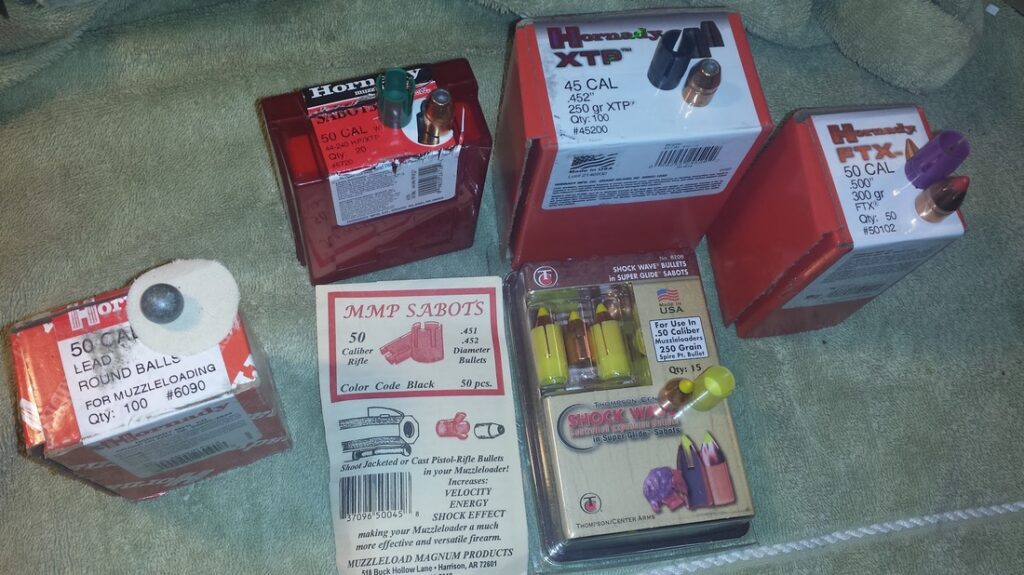
Just some of the bullets and sabots I’ve acquired while determining what is best… the box of lead round balls hasn’t been touched in almost 20 years!
Its not hard to do BETTER:
First, I absolutely recommend that you forget round balls; they have horrible ballistics and poor performance in larger game, especially at longer ranges.
BULLETS: You probably will want to stick with sabots and jacketed hand gun bullets; handgun bullets are designed to be accurate, and expand at velocities your muzzleloader will produce. There are lots of pointed hand gun bullets now like Hornady FTX’s that have improved ballistic coefficients. There are also jacketed ‘muzzle loader’ bullets that frequently come with sabots that work well. 200 to 350 gr bullets are typically used in modern inline muzzleloaders with success. You may find that pointed bullets require special loading jags or their points get damaged and accuracy can suffer. My Remington’s have always liked heavier bullets (250gr or more).
I recommend you stay away from .458 (rifle) bullets as many have thicker jackets and do not expand and perform as well at muzzleloader velocities. But if you can find .458 bullets that are made for a muzzleloader then you may have a great bullet. Also some 451/452 Handgun bullets may have thicker jackets: they won’t work well at muzzleloader velocities (The thicker jacketed handgun bullets are typically labeled “MAG”… stay away from bullets labeled “MAG”).
POWDER: Any modern black powder substitute is better than black powder in my opinion. I found that Blackhorn 209 works the best: I get the best accuracy, faster velocities, no fouling between shots, and its easier to clean up. It does cost more, but sometimes that’s how it is: quality costs.
If I couldn’t get my hands on BlackHorn209, or couldn’t swallow the cost, I’d use loose Triple7even powder.
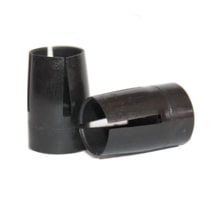
SABOTS: My rifles generally shoot the best when I use the largest handgun bullet I can get a sabot for in the rifle’s caliber:
– In a 54, you can get purple sabots that let you shoot .50 caliber handgun bullets.
– In a .50 cal you can get black sabots that let you shoot .451-.452 hand gun bullets
– In a .45 cal i’d try for tan sabots that use .40cal hand gun bullets
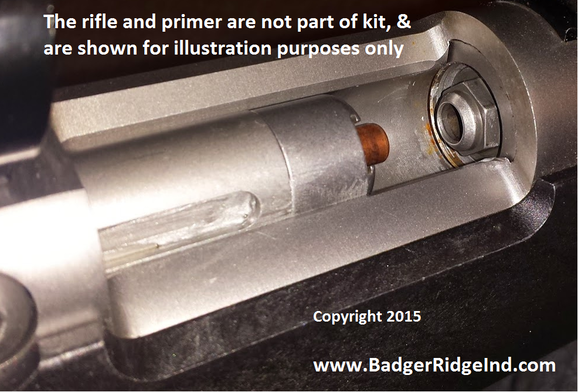
PRIMERS: Any standard 209 primer can work with our breech plug if properly tuned. Some folks play with primers after working up a load and have reported improved accuracy just by changing brands. However as each brand of primer has different dimensions, by switching primers you make suffer a leak or need to re-tune a breech plug, or buy a new breech plug for that specific brand of primer. So, again your mileage may vary. My KISS answer: get whatever standard USA made 209 you can could find a lot of stick with it.
But, hands down I’ve found the older copper standard CCI primers worked the best. Mostly because they always fed and have never stuck in a bolt nose on me. The new CCI 209’s are silver and I haven’t played with them much to endorse them. So I’d use whatever USA made primers I could find and stick with them: CCI’s (standard or magnum), Federal (standard or Magnum), Remington STS, or Winchester.
Anyways, I’ve had primers , even CCI magnums stick at low powder charges and require a dry fire to remove. Winchesters are the worst in our Remington 209 conversions as far as sticking in the nose. However, a dry fire has always removed any stuck primers for me.
My rifles shoot good enough, with my older CCI’s, so I’m not fiddling with primers until I shoot through my stash: I’m sticking to what I know works.
Bottom line: Any Standard (or Magnum) 209 shot shell primer will ignite any black powder or substitute. Blackhorn209 won’t work reliably with ‘muzzleloader’ 209’s (777, Kleanbore, CCI Inline Muzzleloader, etc), so you see I don’t recommend messing with muzzleloader primers in general. They do work just fine with all black powder and substitutes besides BlackHorn209.
WHAT I’VE FOUND TO BE BEST (in a 50 Cal)
Black MMP Sabots, 300 Grain, 451/452 Jacketed Handgun bullets (like Hornady XTP’s and ‘non MAG’), and somewhere between 80 to 100 grains by volume of BlackHorn209 powder, standard 209 primers (Federal, CCI, Remington, Winchester… not ‘muzzleloader’ 209s).
Why do I recommend this as best?
As for conicals, power belts, bore-loc’s, minet’s etc… I personally I’ve seen better terminal results on game with sabots and good jacketed hunting bullet, but some of the new conicals (ie not most of the powerbelts) are a good option too as far a terminal performance. The only conical that works well with BH209 seems to be the newer Hornady Bore Drivers.
My opinion on PowerBelts: You could use powerbelts (just not with Blackhorn209), but they do have a bad reputation for under performing on game in many situations. Besides not working well with BlackHorn 209, I have always done better staying away from them; I’ve read a lot of bad things about some of these as all but one version of the powerbelt doesn’t have a good copper jacket that controls expansion, while holding the bullet together. However your rifle may like them, and they are ‘good enough’. Just remember: Blackhorn209 has trouble with these sort of projectiles that require the initial expansion of the powder charge to seal them to the bore… especially in a Remington 700ML. If you are using Blackhorn209 you should stay away from these and use sabots!
Advice on choosing a sabot for better or best results: You will probably have the best accuracy with the thinnest sabot petals. I’ve read in various books that its because the sabot separates from the bullet ‘cleaner’ and quicker with thinner petals… I’ve also heard its because the thinner petals allow for better concentric alignment of the bullet to the bore. Honestly, thinner petals just seem to work; I don’t claim to know why, nor do I really care about the ‘why’. I believe it be true because I’ve seen it prove out at the range: Use the sabot with the thinest petals for best accuracy.
Remember what I said about .458’s above… they will give you thinner sabot petals, so you proably can get them to shoot well, but are they the bullets with thinner jackets that are made to expand? (Too many 458 bullets are thick jacketed and made for centerfire rifles used on large/dagerous game). If you know the bullet is made to expand at low speed and you can find sabots for them in your .50 you may have good results.
While 458’s are a mixed bag, as long as you stay awy from the “MAG” 451/452 handgun bullets you can pretty much be assured you’ll get prpoper expansion: so that’s why I say that 451/452 jacketed handgun bullets are better: I can be really sure they will expand properly.
So my recommendation of what is best, is counter to what some would like… ie the smallest diameter bullet, with the highest BC, going at the fastest speed (requires thick sabot petals). From what I’ve seen accuracy is all about thin sabot petals. And its accuracy that lets you reach out and hit distant targets where you want. High velocity and fast flat shooters help at range, but only if they are accurate to start.
I know my 50 cal rifles shoot black MMP sabots with 45 cal bullets better than they do green MMP sabots with .44 cal bullets… or with harvester crush rib sabots… but not by all that much. I haven’t proven this with my .54 yet, but so far it shoots purple MMP sabots with 50 cal 300 grain FTX bullets very well. So well I don’t know if I’m going to do any more development… I’ll probably just use it as a loner/back up rifle and hunt it as is.
All that said, I have clients that swear their 50 cal rifles love the 44 cal bullets with MMP green sabots.
I have one 50 cal rifle that likes 250gr XTP’s the most. It shoots them noticably better than 300gr XTP’s, or 250 or 200gr FTX’s… I wish it didn’t because I like the idea of slightly flatter shooting (of the pointed FTX). I still load it with 250 gr XTP’s when I’m shooting at deer… because that is what that rifle shoots best. At this point I think I’m rambling and you can see that we may be splitting hairs when it comes to BC’s and velocities in muzzleloaders.
So your mileage may vary!
Bottom line: Stick with Sabots, handgun bullets, full power 209 primers, and Blackhorn 209 and you’ll definitely be doing better and perhaps even best…
How do you get the best out of your rifle? I suggest you take a few of the better options above, go to the range, apply the safety rules and procedures you find in the Owner’s Manual and see what your rifle likes.
Your way forward: If you don’t own any muzzleloading components yet, I encourage you to convert your Ruger 77/50 or your Remington 700 ML to our 209 kit, and pick up some MMP Sabots from us. Then go to your local sporting goods store and get a box of correlating size quality handgun bullets, 209 Primers, and Blackhorn 209 (along with standard black powder accessories like a powder measure, flask, starter, etc).
Read the owners manual and the directions on your powder bottle. Then go to the range and work up your loads as they direct.
Hope this helps and sets you on a good safe path. Truth is that you have a lot of choices to make. In general, if you pick better components and loose powder. Then work up per the manuals, you will probably quickly find out what works very well if not best.
Always follow the ten commandments of shooting and special muzzle-loader safety rules
Comments from our old website I though were worthy of moving over with this article:
Comment from John 9/8/2020
Many years now with the 209 conversion. LOVE IT!!! I highly recommend it. I shoot Black 50 Cal MMP sabots and 45 hand gun bullets with 100grs loose powder and at 100 yard 1″-1 1/2″ 3 shot groups.
Thanks again for a great upgrade.
John
Reply from Badger Ridge 9/9/2020Thanks for the positive feedback! We appreciate your business!
Comment from Bruce Hicks 3/31/2020
I am interested in your 209 conversion kit hows the grouping after conversion Thank You Bruce
Reply from Badger Ridge 3/31/2020
While we make no claims on accuracy, the kit does tend to improve it, as sealing up the leaky breech tends to produce more consistent pressure, which usually translates into more consistent velocity, and hence better groups. But really there are so many factors in accuracy (namely the guy behind the trigger), that we cannot make any claims.
Comment from John Brackin 10/11/2017
I just had my older Remington ML700 converted with your Badger Ridge 209 conversion kit. Are you are saying that this older Remington can safely shoot 100 grs. of BlackHorn 209?Reply from Badger Ridge: 10/11/2017
Yes, 100gr by volume is in the safe charge range, per the Remington Manual, and the information on the powder bottle. Both state starting load of 80Gr by volume; maximum load of 120gr by volume. My rifles have never shot best at any charge over 100gr by volume.
Comment from Nicolai 9/24/2022
Happy customer here, reporting in on great success with the Cheddite CX2000 209 primers, that are readily available. I spent 5 minutes time tuning ing the breech plug per the instructions, have had zero blowback, zero bulging in the primers. In fact all I need to do is tip the gun to drop the fired primer from the bolt face.
This old remington 700ml now fires 100% of the time with 91 grains of Blackhorn 209 (by weight) with the Powerbelt Platinum 338 grain projectiles. I shot a few 270’s and did not enough the same level of accuracy.
Thank you gents.
Reply from Badger Ridge 9/24/2022
Thanks for the positive feedback.
First, you are using way too much BlackHorn209. 91gr by weight would be an over charge. Go by volume (80-120 gr by volume is the range listed on the bottle). By my math you are 10 gr by volume over… nuts… an over charge can’t be good, much less better, nor best.
Again: All of my rifles have always shot the best between 80-100 gr by volume of BlackHorn209
Also, after about 100-110gr by volume with a 338gr projectile… you will probably be throwing unburnt powder down range… whats the point in that?
Those foreign primers are tricky to get to feed, swage, and seal. That’s why I recommend only US made primers: Glad you got them to work and are satisfied.
Also, I’ve had a customer use a very similar load, and it worked fine when it was 50-60deg F (while he was at the range). He then went out west, was in the mountains with a cold soaked gun, and the Blackhorn209 wouldn’t ignite. I believe it was because the powerbelts don’t seal as well as sabots. And Blackhorn209 needs to be fully sealed or it won’t ignite… especially when its cold and it doesn’t have a 100% sure seal.
The trouble is that there are lots of variables, and one of which is that ‘powerbelts’ have many different versions with different features.
Bottom line: I’d suggest using the Hornady Bore Driver over any Power Belt. Your mileage will vary: best of luck! Hope you bag a bunch of big ones!
Comment from Steven 11/1/2020
I purchased the Badger Ridge conversion kit for my Remington 700ML. The 209 primers get stuck in the slot on the bolt. Is there a defect in the bolt or do I need to try different primers
Reply from Badger Ridge 1/2/2021
Sorry I missed that you posted this question and didn’t post back sooner! (I was hunting out west when you posted!)
Primers stick in the nose in two different situations.The most common is spent/fired primers sticking in the nose. The instructions tell you how to deal with this: dry fire on the spent primer. The second strike of the firing pin loosens the stuck primer. Everytime I’ve had one balloon (typically winchester primers) a dry-fire on the spent primer loosened it and it fell out. I even made a video with some sticking primers that shows this. (And its written in the instructions).
The other time primers stick in the nose is when there are burs from the manufacturing process that grab unfired primers. I test every nose with a primer, look for burs and remove them to prevent this from happening to customers, but I’m not perfect. If you are having unfired primers stick in the nose, look for the burs and remove them (I use a dental pick and small jewelers files), or send it to me and I’ll do it and send it back.
Yours,
Tom
www.Badger-Ridge.com
Comment from Mike Cervantez 3/26/2019
Tom,
Great article. I just purchased on of these muzzleloaders still the box from a friend. I am just a beginner at muzzle loading so this purchase is just a beginning. I have a question about loads. If the heaviest load is 120 grains, do manufactures make pellets in increments of 10 or 20? Or, is this only for powder loads? I know the pellets come in 50 and 100 grains. I have read about guys shooting 150 grains through these firearms but I am not taking that chance. I am good with 100 grains.
Thanks Mike
Reply from Badger Ridge 3/26/2019
I’m far from an expert on pellets: I use loose powder because I’ve found it best to be able to dial in my load. All my rifles have shot best somewhere between 80 -100gr (by volume)/ I specifically love Blackhorn209 (which only comes in loose powder).I’ve only seen 50Gr pellets myself. I’d never risk my life and limb on something I heard on the internet: 120gr by volume is the max for the Remington 700 ML/MLS per Remington’s documentation. Can’t get 120gr when adding in increments of 50gr.
Plus your rifle doesn’t have enough barrel to burn more than about 100grains of any sort of powder/pellet. If you were to shoot higher quanties over snow, or in front of a high speed camera, you’d find lots of unburnt powder/pellets going down range.
Comment from Dan Wescott 9/5/2019
I bought a used 700ML and started with 80 grs of triple 7 powder but was shooting low with original open sights with 223gr powerbelts. I live in Colorado and can’t use sabots here so I’m looking for any information on non sabots that work best for deer or elk. I can easily switch powder to Blackhorn, but can’t switch to sabots. (Wish I could). My rifle has not been converted to the BR209. Any help is appreciated.
Reply from Badger Ridge 9/7/2019
Our conversion kit works great with all powders. Like you mention you have to use a powder that is compatible with your propellant, so if you are not using sabots, BlackHorn209 is not recommended. However Hornady Bore Driver bullets are Colorado legal and seal well (and seem to work well with Blackhorn powder).
I wrote a lengthy blog post here about Colorado rules and what I’d do:
https://badger-ridge.com/getting-ready-for-colorado-muzzle-loader-season-2/
Short answer: Personally I’d use Hornady BoreDrivers or even Thor’s (I don’t care for Powerbelts… they have a bad reputation in terminal performance).
Comment from Mark Ervay 12/9/2019
I have owned the 700ML since they first hit the market. Shot many sabots through my gun using 2 pellets (100gr equiv) with horrible results on accuracy. The plastic casing was burning up and causing the bullet to tumble. I then talked to hardcore muzzleloading guy and he told me the scrap all that and go to loose powder (Goex) and I used Hornady Great Plains.I used like 85 gr of powder and dead on accuracy with that setup. I switched to the Horaday FPB 350 bullet and 100gr powder with the CCI Mag caps and not one misfire. My point here is you need to find what works best for your gun. I will not switch to 209 primers as long as the caps are working fine for me.
Reply from Badger Ridge 12/9/2019Feel free to keep shooting what works and is safe. I’d wonder what bullets you were using with what Sabot… the Remingtons like 240gr or heavier bullets (usually the black sabots with 45 cal 300gr XTP or equivalent will work best in these rifles).
Anyways, when you get your first misfire with the original leaky set up, I hope its at the range and not when you have a nice trophy in your sights! (I get calls from guys all fall who had their first misfire or two when a nice buck was in their sights). When you get tired of crud blowing back into your face and all over the place, are ready to simplify clean up, and go with a better more reliable system we’ll be ready to help you!
Comment from Pell Kennedy 10/24/2022
I’ve had the bolt nose kit on my 700ML since it came out and it’s great…except for putting the primer in place with my arthritic 72-year-old fingers! I drop a lot of them! Is there any kind of gizmo, a capper, to hold the primer and make it easier to put in place?
Reply from Badger Ridge 10/25/2022I don’t know of any tool that would do what you are asking.
One of the design goals was to not require any tools to prime/de prime. To remove the primer I usually just roll the rifle on its side and catch them as they fall out. But you’ve got my wheels spinning as I have arthritis, but not so many trips around the sun… I may come up with something. When I do I’ll post about it here in the Badger’s Den.