This was originally posted at our oldwebsite many times. Reposting it here.
We’ve been selling and installing our great 209 conversions for years now. And I’ve noticed my questions and sales following trends influenced by the various hunting seasons and their associated rules. This time of year many folks are getting ready for Colorado’s muzzle loader season, typically focusing on harvesting an elk. So I frequently edit and re-post this one. The commentary here was also added the to the FAQ (Frequently Asked Questions).
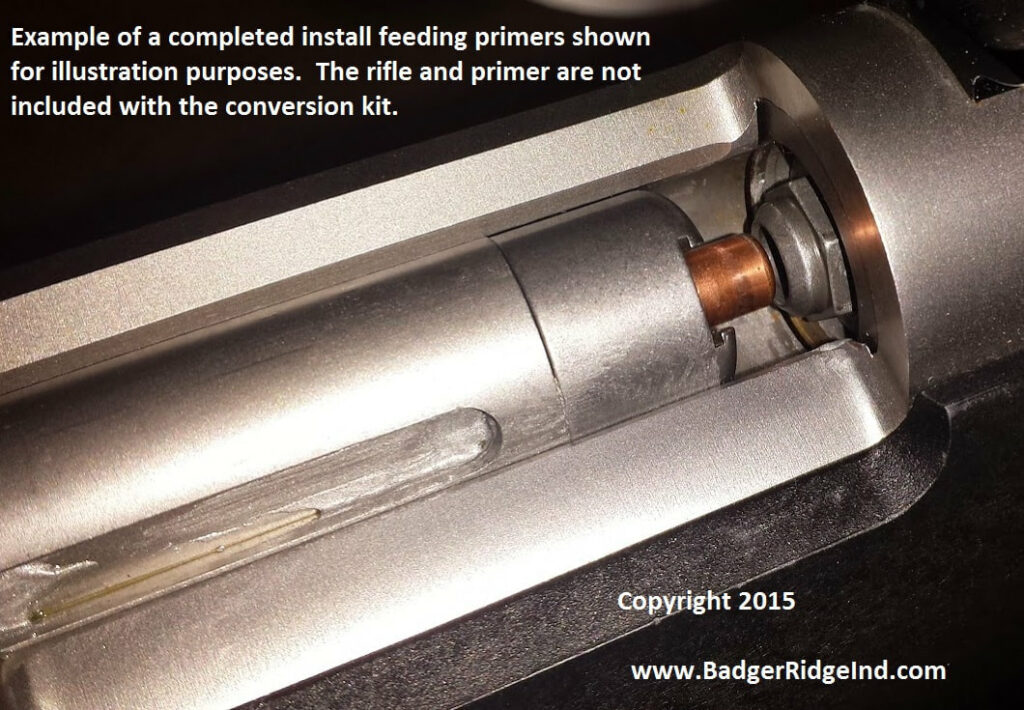
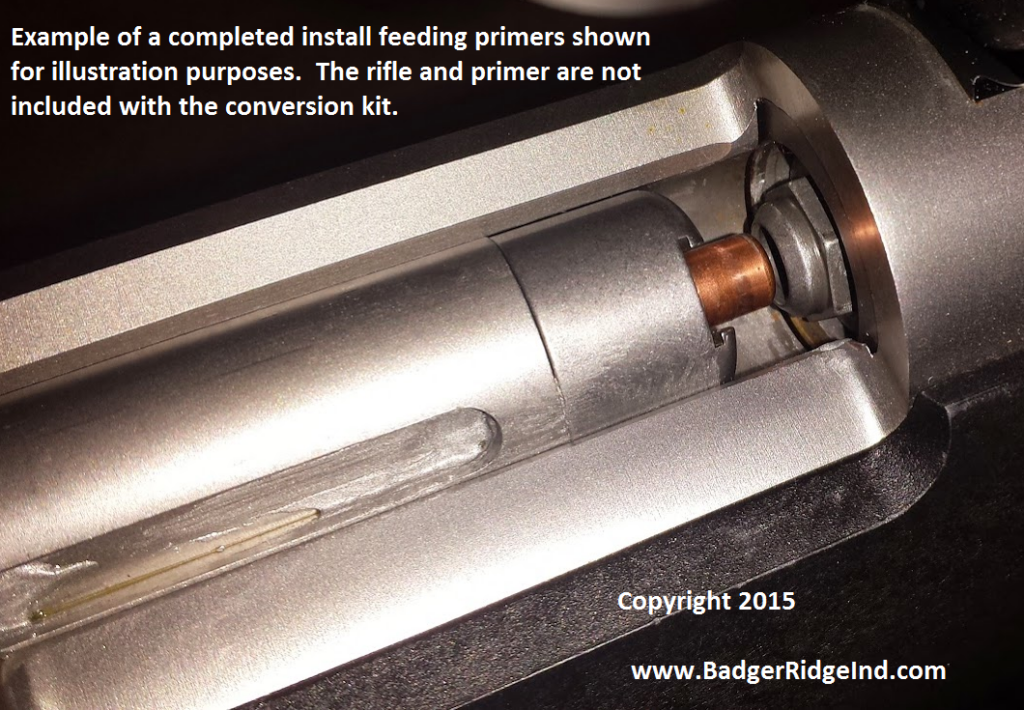
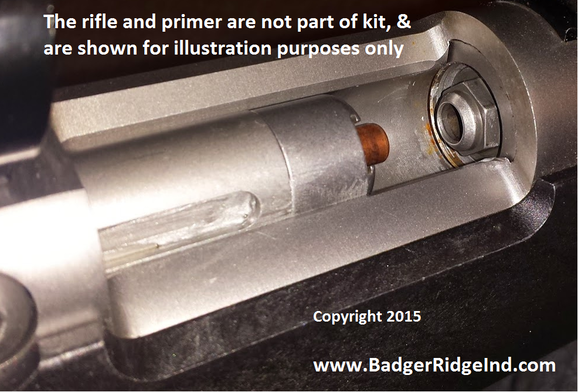
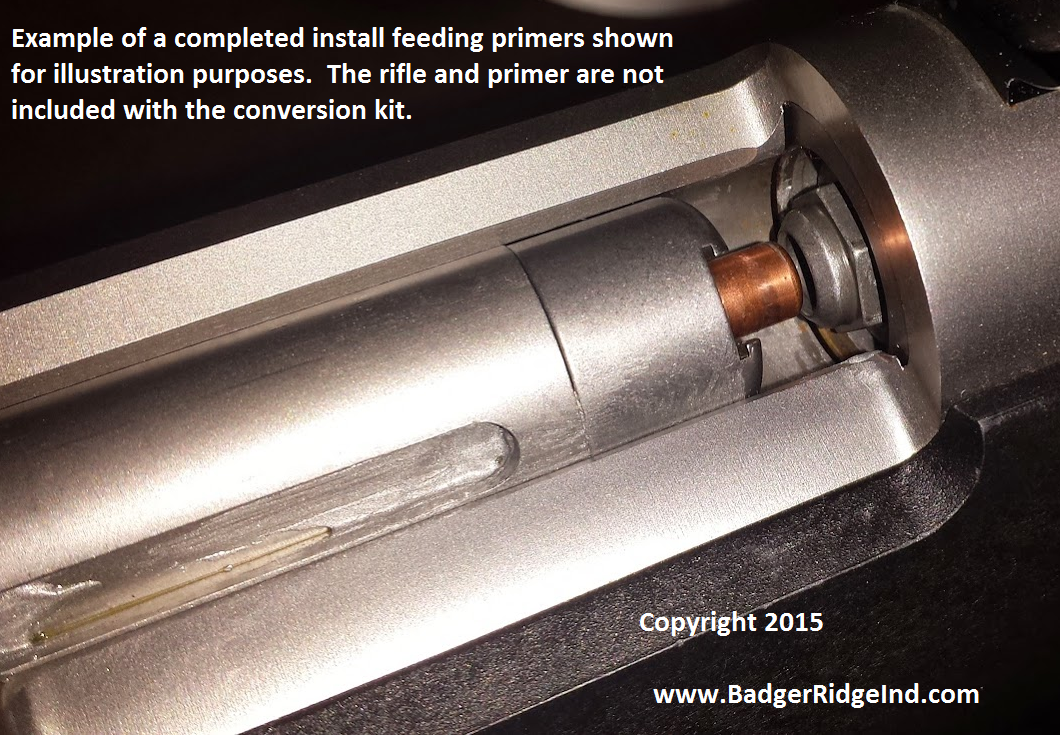
Close up of Remington 700 MLS feeding 209 primer into sealed breech
Q: I hunt in Colorado, sabots are not allowed for hunting during muzzleloader season in Colorado. I want to use your awesome 209 conversion, but you say you recommend sabots with jacketed handgun bullets. What are my options?
A: Short answer is our kit will work great with any projectile. I’ve found Pyrodex, Triple Se7en, and black powder work best with non sabot projectiles. So I suggest that you use our kit and any muzzle loader safe powder (besides BlackHorn209) for your Colorado hunts with Colorado legal projectiles.
UPDATE TO ADD: Some folks are reporting good results with the new Hornady Bore-Driver bullets and BlackHorn209 powder. They have a substantial plastic base on them that seems to seal well and function with BlackHorn209. You may want to try it out yourself.
Long answer:
I realize not all 50 state have the same rules. And some state’s rules are just plain silly. I wrote a blog post about that.
The main thing to remember here: the powder you chose must be compatible with the projectiles you use.
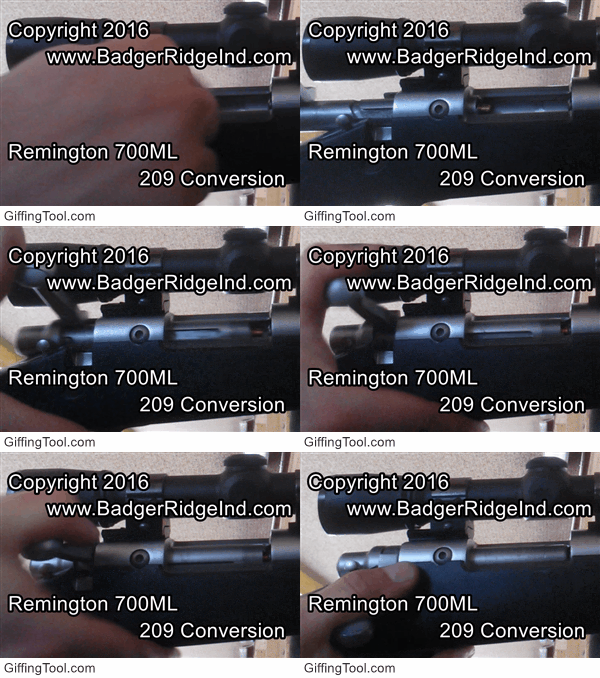
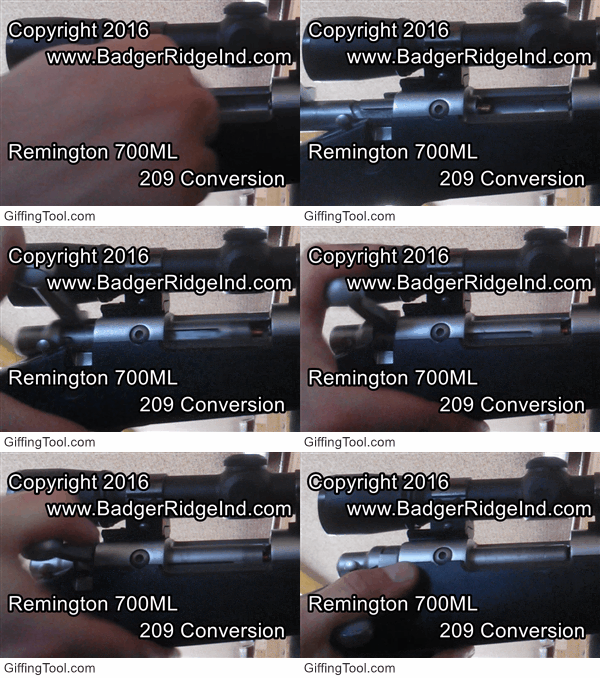
Animated Gif Loading primer in Remington 700 209 sealed breech
Our kit will seal the breech, which keeps the crud out of the bolt and action no matter what muzzle loader safe propellant you chose. Our kit is compatible with all muzzle loader safe propellants: pellets, loose powder, etc. Also using 209’s will give you more ignition heat and thus more reliable ignition over caps. And seeing our system keeps the crud sealed into the breech plug, the 209 is ignited reliably too. But the powder and projectile choice is up to the shooter. Read the manuals/instructions and follow them when developing loads.
Blackhorn209 powder is different from Pyrodex & Triple7even: To be reliable BlackHorn209 needs to be fully sealed; i.e. sealed at the breech (which our kit does), and sealed at the projectile. Minnie balls, minet, power belts, B.O.R. Lock MZ and other easy loading projectiles that are legal for Colorado muzzleloading, don’t usually seal until the powder combusts and forces them into the grooves. This deformation sealing the bore after combustion is called obturation. The problem is BlackHorn209 doesn’t burn well until it’s sealed and can build pressure. So it’s likely to have bloopers, miss fires, and hang fires with obturating projectiles. Sabots seal well to start, thus if you are using BlackHorn209, it’s recommended to use sabots.
Though the new Hornady Bore Driver bullets are reported to seal well and work with BlackHorn209, I haven’t tried them myself.
Never use smokeless powder in your Remington/Ruger! It says it right on the barrel!
Because Colorado doesn’t allow sabots during the muzzle loader seasons I would stay away from Blackhorn209. (or with a lot of trial, I may try the Hornady Bore Drivers).
Otherwise, If I was hunting in Colorado, I’d use our kit, choose a heavy projectile (250gr or more) that seals on ignition: Hornady BoreDriver, Thor, minie ball, lead conical, etc. But without a lot of testing, I wouldn’t use BlackHorn209; I’d try Triple7even, or Pyrodex. Although they are not as easy to clean, and will foul the barrel, they are very easy to ignite even when not sealed, and will obturate the projectile. Black powder will work just fine with these sorts of projectiles too.
I do have a few clients that report success with Blackhorn209 and magnum primers (CCI 209M or Federal 209A) using Hornady FPB’s or its aforementioned replacement: Bore Driver… and also with Thor bullets. I also had one that said the Thors worked well at the range, but didn’t fire when he had a nice bull in his sights. He said it was extremely chilly that morning, his rifle was cold soaked, and the Blackhorn209 wouldn’t go bang. He was very frustrated. I’ve heard the same report from folks using Powerbelts: worked ok at the range, but when cold soaked their rifle woulsn’t go bang: I suspect it was because the projectile shrunk with the cold, and the copper jacket or plastic skirt wasn’t quite as malleable. Also cold powder is just a bit harder to get burning, and thus that setup was unable to obturate the looser projectile and keep the BlackHorn209 burning. So I wouldn’t use BlackHorn to hunt with most obturating projectiles.
Thus without a lot of testing (like putting a loaded rifle in a freezer, pulling it out and shooting the combo… repeatedly). I would stick with Pyrodex or TripleSeven for Colorado muzzle loader hunting: they will go bang with an obturating bore riding projectile when you need it, even when it is very cold.Or I would use Hornady Bore Drivers (they have a big plastic base and seem to seal well).
Just about everywhere else, I recommend sabots because they have been accurate, easy to load, and jacketed hand gun bullets have always been very effective for me. Whatever powder you chose, the velocities your muzzle loader will produce are essentially the same that good jacketed handgun bullets are designed for. They tend to kill quickly and bring home game. Sabots are allowed in most states, so that’s what I usually recommend.
Long-term: If I voted in Colorado, I’d pressure my legislature to change the muzzleloader rules. Removing the most effective projectiles (jacketed handgun bullets are great in muzzleloaders), and the most modern muzzleloading propellant (Black Horn 209) from use is bad for the game receiving the projectile. I believe the no sabots rule promotes wounded/lost animals.
Your muzzle loader not going off when you want? Blackhorn209 giving you trouble with reliable ignition? I think we have some answers to what works and how we got here.
Orginally posted to our old website on 9/25/2020 (updated and reposted here to preserve it
Loading a 209 sealed breech system on a Remington 700 MLS
Welcome to the Badger’s Den! If an internet search brought you here searching for Savage, Remington or Ruger muzzle loader solutions, don’t worry you found the right place! Stay with us! Keep scrolling, Click here, or Look at the banners at the of the page or the right side etc for what you are looking for!
For this installment I’d like to discuss the different types of 209 primers you can use in your muzzle loader and how we got to the point where you have to understand what is compatible with what in order to have a reliable shooter. I’ll also be adding this to our FAQ (Frequently Asked Questions).
Q: Why do you recommend I don’t use muzzle loader primers in my muzzle loader? Why did the “muzzle loader 209 primer” I tried with Blackhorn209 fail but the standard or magnum 209 primer worked? Why does Western Powders (makers of Blackhorn209) say to use magnum primers, but you say I can use standard primers or magnum primers, but not “inline muzzle loading” 209 primers? Why does the primer say it’s non corrosive, but you say I need to clean my muzzle loader soon after shooting because it will corrode? I’ve got a stainless muzzle loader, do I really need to clean it after shooting?
A: These are all Good questions with seemingly contradictory information.
If you want the short answer, and you have a Remington 700 ML/MLS or a Ruger 77/50, the short answer is: buy our conversion kit, use full powered standard or magnum 209 shotgun primers and pair them withSabots and Blackhorn209. Clean your muzzle loader thoroughly after shooting.
The short answer also can be summarized as: not all muzzle loader and gun cleaning stuff is compatible with all other muzzle loader and gun cleaning stuff. Read and follow each item’s directions. Our kits seal the breech, so our kits are compatible with any muzzle loader powder. Using our kit helps simplify much of the compatibility issues.
If you want the long answer, please keep reading:
Remington 700 Modified with our 209 system feeding a primer into the breech plug to seal it up and improve performance and reliability
The long answer is, well… long:
First lets talk about primers in general and then some history of modern muzzle loader and black powder substitute development. Then BlackHorn209 muzzle loader powder.
Yes: modern primers (and percussion caps) have been non-corrosive for years. Corrosive primers formerly used fulminates, like mercury fulminate: their residues are corrosive, but for quite some time most western countries have used other non corrosive stuff (like lead styphnate). The Eastern Block countries were slower to adopt non-corrosive primers, which is why you are likely to run into old ammo from them that has corrosive primers. So today primers are still labeled corrosive or non-corrosive… FYI corrosive primers that use Mercury Fulminate attack brass and make it brittle. You want to avoid trying to reload any brass fired with corrosive primers… especially if it has had the residue on it for a while.
Regardless of the primer/cap, Black Powder and most substitutes produce corrosive residue (aka fouling). In the unique case of Blackhorn209 it’s fouling is not corrosive, but it is hygroscopic (which coats the bore with water that promotes corrosion). So you need to clean any muzzle loader using Black Powder or a substitute soon after firing.
Some manufacturers responded to this by offering coatings, like cerakote, nickle, etc… others use stainless steel to protect the gun from the corrosive fouling. Regardless of steel or treatments that may slow the corrosion, cleaning after shooting is still required to protect the metal from the effects of these residues. Also breech plugs and their components (along with bolts in leaky breech setups) can be fused into the rifle by the fouling alone. Then factor it the fouling’s corrosive tendancys: if not properly protected before firing and properly cleaned after firing a breech plug is likely to get stuck.
Breech plug left uncleaned and covered in BH209 residue (has been cleaned and scrubbed now)
Further complicating things is that Black Powder and most of its substitutes’ fouling builds with each shot, and tend to be sticky. This fouling will bind and cement stuff together, like breech plugs into barrels. Blackhorn209 is the exception here. It has no more fouling on the 500th shot than after the first, and its fouling is not sticky nor does it tend to lock stuff together. See the breech plug above… it corroded but didn’t get stuck in the rifle after being neglected (it didn’t stick liekly because of the BlackHorn209 powder). But I’ll get into Blackhorn later.
Crud rings became a problem when the venerable standard 209 primer’s with so much more priming compound than percussion caps were introduced to muzzle loading. The crud ring forms near the breech (with Black Powder and all its substitutes… except Blackhorn209). It’s caused by the organic residue of Black Powder (and its first substitutes) mixing with the inorganic residue of the priming compound.
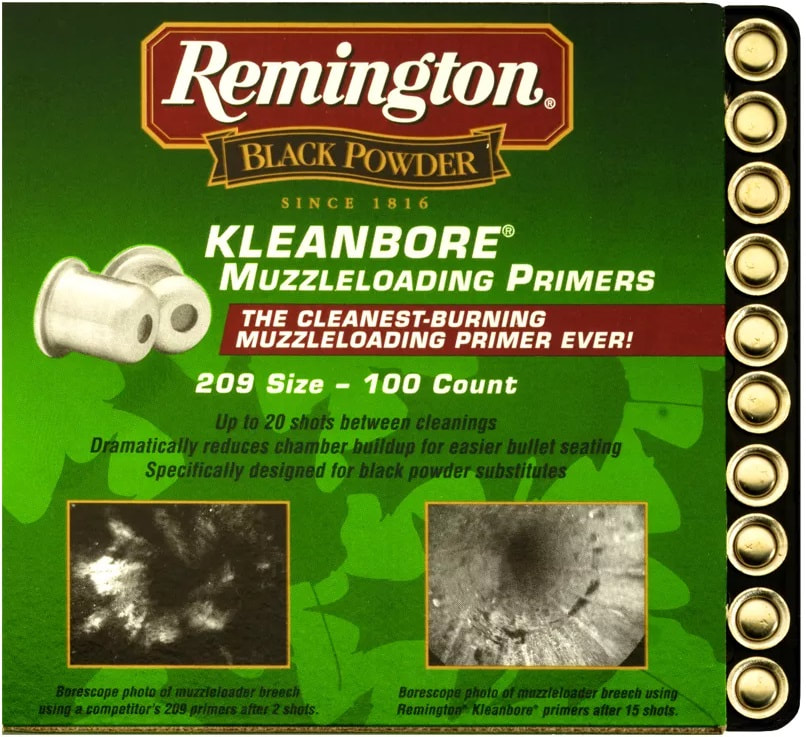
These are cooler muzzle loader primers that reduce crud rings (but don’t work well with BlackHorn209)
Reduced powered inline muzzle loader 209’s (Remington “Kleanbore”, Winchester “777”, CCI Inline muzzleloader, etc) were created to combat the “crud ring.” Standard shotgun shells are loaded with smokeless powder and smokeless needs a bunch of priming compound to get it burning reliably. So standard 209’s are pretty darn hot. With “muzzleloader” 209’s, the basic idea is to introduce less inorganic priming compounds because Black Powder and most of its substitutes are reliably ignited by lower charges than a typical shotgun 209 produced. Reducing the inorganic contaminates makes less of a crud ring and makes it easier to clean the crud ring (when cleaning between shots). So that makes these “muzzle loader” primers hotter than a percussion/musket cap, but cooler than a standard 209 primer.
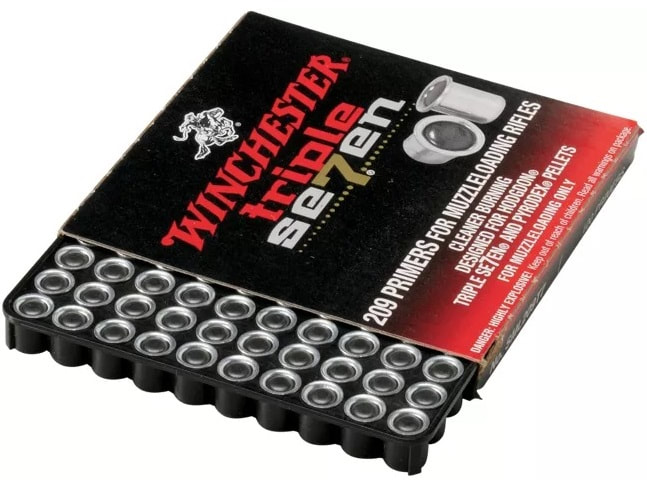
These are Winchester’s muzzleloader primers (they don’t work well with BlackHorn209)
However, the logic runs a bit circular when looked at retroactively… guns were designed to use 209s in order to leverage their hotter ignition and hence become more reliable (and of course they were marketed as such and the industry made money). Then more black powder substitutes that were easily ignited, but had organic chemistry were introduced (777 etc, they were marketed as better than Black Powder and the market made money). But the guns became harder to reload/clean because of the crud ring… so the manufactures created “Inline Muzzle loader 209” primer’s that aren’t as hot but works well enough to ignite most powders and reduce the crud ring (and are marketed as cleaner, but not as less powerful… and the industry makes money). This frequently confuses folks new to the sport… intuition says use the primers labeled ‘muzzle loader’ in your muzzle loader. Also a general desire to always have the most powerful stuff would mean folks wouldn’t buy the “muzzle loader” primer if they knew it was less powerful: So who would label their primers as less powerful? Folk would want to get the more powerful standard or magnum primer and use that wouldn’t they?
So thats starts some confusion and varying advice on what to use in your muzzle loader. We hope to make it clear what to use and why… so keep reading to find out the rest of the story!
Some folks stuck with the more powerful standard primers,,, and occasionally found that if they were shooting easy loading projectiles (aka obturating projectiles that don’t seal well or lodge tightly in the barrel until deformed by powder combustion: power belts, bore lock MZ, minie balls, etc), that they lost accuracy with the magnum or standard 209 primers, but when they tried the muzzleloader primers the same loose bullets and powders grouped well. They reasoned they were un-compacting the powder charge before it got fully burning with the more powerful primers. There’s so many factors, who knows what the cause is, but the remedy seemed to be using the low powered primer when that rare case arose where full powered primers would not shoot accurately. This also reduced the crud ring.
Still, I always suggest folks try standard or magnum primers first. If they can’t get a good group, –and they are not using BlackHorn209--, then try the primer with the name of the powder they are using or another muzzleloader specific primer (ie try full powered primers first; if you are shooting 777 and it won’t group, try the Winchester 777 primer… or any other low powered muzzleloader 209 primer). Getting a difficult to clean/load situation from a crud ring? Switch to reduced powered primers.
Why do I suggest that you try magnum or standard 209’s before “muzzleloader” 209s? First, the muzzle loader specific 209’s have always been about double the price of standard 209’s. I assume that is because they just don’t make as many. Second, if you can get it to work with more heat, then that seems better to me as more heat will compensate for other issues when you are in less than ideal situations… like its raining or snowing on a hunt and a big buck appears in front of you.
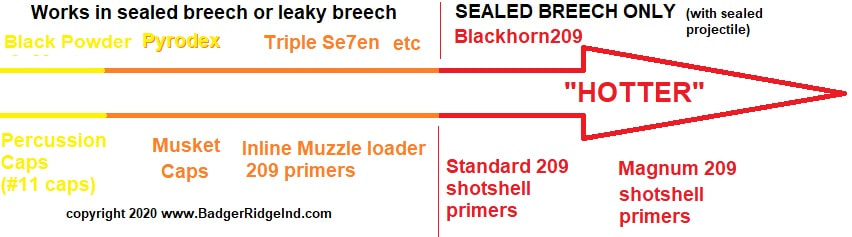
Note this is showing primers related to how ‘hot’ they are and how hot (or sealed up) a powder needs to be reliable. A hotter primer can ignite a powder lower on the scale (A standard primer easily igntes black powder).
Of course if they are using our kit to seal the breech, I always suggest they stay away from obturating projectiles and use sabots with Blackhorn209 and full powered or magnum primers. Our kits work with all 209’s, and all black powder/substitutes. The real question is whether the propellent you chose is compatible with the projectile you choose.
Blackhorn2009 is not compatible with obturating projectiles (projectiles that don’t seal until deformed by the burning/expanding powder charge) and is not compatible with weaker “muzzle loader” primers.
After reduced power “Muzzle loader 209’s” came out Western Powders introduced BlackHorn209 (which is nitrocellulose based) and needs at-least a standard 209. Nitrocellulose is inorganic and cleans up with solvents that also dissolve priming compound residue… so no more soap and water/Windex, no more crud ring, no more fouling in the barrel that builds up with each shot (though you can still get priming compound built up and blocking a breach plug’s flash channel… you may need to pull and clean the priming compound residue from your breech plug every 5-10 shots or so).
So now-a-days we have “muzzle-loader” primers that are not hot enough to set off nitrocellulose powders (like typical shotgun shells use). And now we have a great powder called BlackHorn209 that has a good bit of nitrocellulose in it and thus needs standard or magnum 209’s to go “bang”. However the intuition of some folks is to use the stuff labeled the same as the purpose… got a muzzleloader, so you use “muzzleloader” 209’s… right? Definitely wrong when using BlackHorn209.
Why bother with BlackHorn 209? Its just a better solution! First, it makes a lot less smoke… you shoot an animal, you have a ton less smoke to look through and watch it run off/fall over dead. Also, because it doesn’t build sticky fouling: It doesn’t require cleaning until the end of a day, and it cleans with standard gun cleaning stuff like Hoppies etc. Standard gun cleaning stuff was made to clean up priming compound residue and nitrocellulose fouling, copper fouling, lead fouling, plastic fouling etc, but these modern cleaners do not work as well with Black Powder fouling (along with most of its substitutes).
BlackHorn209 performs better. It tends to be more temperature stable than BP and its substitutes… ie it doesn’t swing as high or low as they do with large temperature swings… (not saying it isn’t affected by temperature… just saying it doesn’t swing as much). And is generally regarded safer as its harder to detonate than black powder. Just look at its MSDS if you want the specifics. If you were to chrony 300gr projectiles with equal volumes of BlackHorn209 against any other Black Powder or substitute, you’ll find BlackHorn209 has an edge in velocity. All of this is why I use and recommend BlackHorn209 with sabots and modern jacketed handgun bullets. Bottomline: you have to use standard or magnum primers with BlackHorn209.
This further gets hard for the novice as most stores typically stock muzzleloader only things in the ‘muzzleloader’ section, but if they have a reloading section that is where they put the standard or magnum 209 primers. Then guys who just want to shoot, hear that BH209 is better, or see a new thing on the shelf, and buy some along with the ‘Muzzleloader” primers in the same “muzzleloader” section. Then try to shoot it in a leaky breech or with a projectile that isn’t sealed setup… and it fails.
They get mad and rail against BlackHorn209 powder. Remember nitrocellulose needs to be sealed/fully contained to burn properly, the simple answer is sabots… and standard or magnum primers. Some may interject that there are other more experimental ways to seal a projectile. Yes there are but I won’t address them as they are not mainstream.
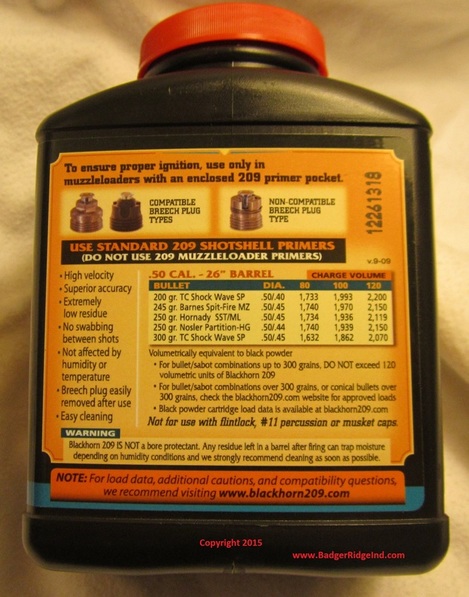
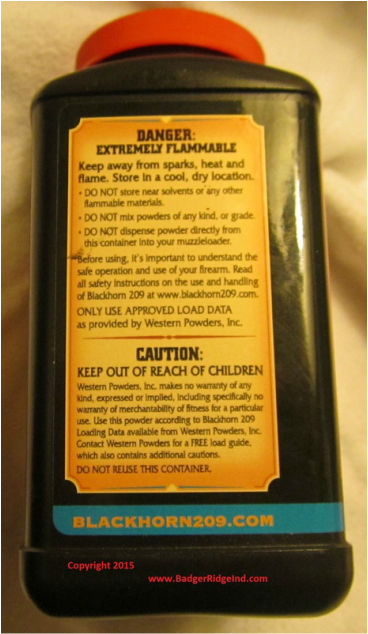
Back of a Blackhorn 209 bottle. Note what it says about primers, compatible sealed breech systems, and min/max loads
Remember the issue isn’t the powder. It’s because the gun is leaky… and/or they didn’t clean the flash channel and burnt primer compound is clogging the breech plug, and/or the breech plug wasn’t made to shoot blackhorn209, and/or the weaker muzzle loader primer is used… and/or the projectile isn’t sealed (like Bore lock MZ’s or powerbelts in some rifles)… In those cases: Blackhorn209 bloopers, misfires, or hang fires, and folks get upset and blame the powder… when they should be blaming themselves for not reading/following the instructions on the bottle of BH209, and/or walking over to the shotgun shell reloading section and grabbing full powered or magnum 209 primers. Or googling it and finding a thread here where I explain how to get it to work in an old muzzle loader built before BlackHorn209 was on the scene (like having us retrofit a vent liner into your old breech plug)… or…
Then you get to today: where some of us make a living helping folks through the mess and getting them to simple effective sealed breech solutions. As most of the mistakes have been made, and most of the answers are in the product’s instructions, or posted/explained/sold here.
As for Western Powders (now owned by Hodgon Powder Company) recommending magnum primers for use with BlackHorn209… all I can do is wager a guess. (I don’t work there nor can I speak for them). I –think– its a combination of: that is what they tested, and tested, and tested. Factored against: if you want it to reliably go off for the best customer experience, have them get the primer with the most priming compound that may correct for a user error (like not fully sealing the breech or projectile, not fully removing oils and contaminates, not cleaning well, etc). Also if hunting in extreme cold, I do recommend magnums myself. Though I must admit, I’ve never myself seen an issue setting off Blackhorn209 with standard primers that were sealed into our kits when using sabots, but I don’t get a lot of negative temperatures to test in (nor do I really want to go out in those temps and shoot a lot).
Perhaps on another installment we’ll discuss how all the 209 primers vary in dimension depending on the company producing them! (important for sealing up 209’s into the breech!)
Also don’t forget that all breech designs are not equal. Leaky breeches not only cover the shooter, the gun’s internals, and any optics in that same nasty fouling, but are hard to maintain and not as reliable as sealed breech systems. Keep reading through the Badger’s Den for answers and explanations on leaky breeches, why and how we seal them up.
Developing a load for your Remington 700 ML/MLS muzzle loader (originally posted to our old website on 11/26/2015) reposted and edited. A lot of this applies to the Ruger 77-50 but this post was written before we started supporting that rifle too.
I often am asked what loads I recommend for Remington 700 ML’s with our 209 conversion kit. When I compose my reply I try to stick to generalities, because it doesn’t matter much what I like, but what shoots well. And you can’t know that without some serious range time. Thus I like what makes sense to me and my rifle shoots well.. but that is in my rifle. Will it work in your rifle? Maybe.
Really what matters is what delivers the damage desired to your target. Also here, I’m not an expert, but I consider myself fairly well read. So I stick to generalities that make sense to me and in developing loads for my rifles what I read seemed to hold true.
Lets handle this in a manner I learned from a wise counselor. In such matters there are typically not absolutes, but ranges. And I like to stick to these three ranges: Good, Better, and Best. Of course if something is “Better or Best”, it fulfilled the requirements of “Good” and did better or was the best. Also “Good” could probably be called “Good Enough.” To keep it simple, I’ll just stick with “Good” on this post. For me, in regards to firearms, “Good” really means safe and effective.
So for owners of a Badger Ridge 209 converted Remington 700 ML we need to start by looking at what the Remington Owners Manual says about performance and safety in regards to bullets, primers, sabots, and powder. If you’ve never read the owners manual, you should! Right now! (Same is true for you Ruger 77/50 owners… read your manual!)
The excerpt below is from page two of the Remington 700 ML Owner’s manual, “Safety is Critical to Performance” (I added the bold and underline for emphasis):
“A superbly crafted gun is only as good as the hands that hold it. You can never be too careful. Shooting accidents are often caused by careless oversights such as failing to control the direction of the muzzle, failing to fully engage the safety, leaving ammunition in the chamber or using improper loads.These oversights can result in the destruction of life, limb or property. There’s no calling back a bullet once it’s been fired, so it’s critical that you know the principles of safe gun handling and storage before you ever take your new Remington firearm out of the box.
The proper use and performance of your firearm depends on correct assembly and maintenance, so it’s critical that you familiarize yourself with the information in this instruction book. Even if you’re a veteran shooter with a collection of Remington firearms, take the time to read this literature. Not all firearms are the same. That means the first step in safe handling is to learn the features and requirements of your new Remington.“
Ok, that’s a lot of good stuff there, but lets emphasize that if you use an improper load you are making an unsafe act. You may get a way with an unsafe act for a short time… until you don’t. I don’t consider any unsafe act as “Good”, thus it could never be “Better” nor “Best”
So what is an acceptable load? Well first lets see what the manual says about loading… and here we have to remember that the manufacturer of the rifle never tested it with powders like Blackhorn 209 (most blackpowder substitutes were not available while the rifle was was in production. Back then there was essentially only black powder and Pyrodex.
Also there are many good options for bullets, sabots, etc now that were not available when the Owners Manual was written. Factor in that with our 209 conversion you have changed the priming method and breech plug and you should realize that you do need to run what it says through the filter of progress in regards to percussion caps, and powder.
Please take the time to read the excerpt below. Below is excerpted from Page 6 of the Remington 700 ML Owner’s Manual... (my comments will be in bold and in parenthasis)
SPECIAL SAFETY RULES FOR MUZZLELOADERS
In addition to the Ten Commandments of Firearm Safety, there are several guidelines specific to black powder guns that muzzleloaders must observe at all times to ensure their safety and the safety of others. The following is a brief overview of these guidelines. For full details, thoroughly read this instruction book.
MUZZLELOADING SAFETY RULES
1. NEVER smoke while using your muzzleloader or while near any quantity of black powder or PYRODEX.® (Same is true for any powder)
2. BEFORE LOADING, MAKE SURE THE FIREARM IS NOT ALREADY LOADED. To make sure it is unloaded, insert the ramrod provided with the rifle into the bore to the breech plug and note its position at the muzzle. It should be approximately 1/4 inch below flush with the end of the barrel if the rifle is not loaded. (Badger’s Note: that is with the OEM breech plug, with our breech plug your ram rod should sit just above flush with the muzzle on and uncharged rifle).
NOTE: Nothing can be attached to the ramrod while using it in this way. USE ONLY THE RAMROD PROVIDED.
3. ALWAYS CHECK AND CLEAR THE FLASH HOLE THROUGH THE NIPPLE BEFORE SHOOTING. ALWAYS CHECK THE BARREL FOR OBSTRUCTIONS BEFORE LOADING AND SHOOTING. Before checking for an obstruction, put the safety mechanism in the ‘S’ position and open the bolt assembly and remove the percussion cap and residue from the nipple. Water, snow, mud or any other material can obstruct the barrel and cause barrel damage. (with a 209 conversion you must realize the same is true, but instead of caps and nipples we have primers, flash cambers and vent liners)
4. USE BLACK POWDER OR PYRODEX® ONLY TO LOAD YOUR MUZZLELOADING FIREARM. Never use even small amounts of smokeless powder, even if it is black in color. The use of any other propellant may cause injury or death to the shooter or bystanders and damage the firearm. (So by using other black powder substitutes you are operating under the engineering of the powder manufacturer, not the rifle manufacturer. If you read page 12 you will see why Pyrodex is OK… so you’ll have to read and understand the same for whatever black powder substitute you may choose… like Blackhorn 209. )
5. NEVER EXCEED THE MAXIMUM RECOMMENDED POWDER CHARGE CONTAINED IN THIS BOOK. To do so could result in injury or death to the shooter or bystanders. (Pages 16 and 17 state 120 grains (by volume) as the max, older versions of this manual had a 150 gr by volume for the MLS or “Magnum” version… I recommend you stick to this safer, more conservative 120gr by volume max… also if you choose Blackhorn209 you see it’s manufacturer lists 120 gr by volume max as well).
6. NEVER POUR POWDER DIRECTLY FROM A POWDER FLASK OR CONTAINER. A sudden powder ignition from a lingering spark could cause the entire flask to explode. Use an individual charge from a powder measure when loading your rifle. Read and follow your powder manufacturer’s procedures for powder storage.
7. NEVER USE THE WRONG AMMUNITION COMPONENTS. Only use ammunition components that exactly match the caliber markings on your firearm and are meant to be used together. Use only pure lead or Remington® brand loading components when shooting lubed conical bullets. Do not use any other lead alloys with lubed conical bullets as they may be too hard for proper and safe use in your muzzleloader. (so when you use other bullets you are not under the engineering of Remington, but your own or the bullets manufacturer… only use 451-452 bullets in a 50 cal rifle with black sabots… etc)
8. WHEN LOADING, BE CERTAIN POWDER, PATCHES AND PROJECTILES ARE IN THEIR PROPER SEQUENCE AND THAT THEY ARE COMPLETELY SEATED AGAINST ONE ANOTHER. Serious personal injury or death can result if space is left between them. To provide a reference mark for future loadings, mark the ramrod at the muzzle once a projectile has been loaded to the proper depth. NOTE: Be sure to recheck the ramrod mark if you change loading components or alter the ramrod. See Picture 13 on page 15. Never attempt to shoot out a projectile that is not firmly seated against the powder charge or does not seat to the proper depth. Remove these projectiles following the instructions on pages 18 and 19. (witness marks are key to safety!!!)
9. ALWAYS USE COTTON PATCHING. The use of non-cotton patching could build up a static electric charge possibly creating a spark that could ignite the powder.
10. NEVER POUND THE RAMROD. Black powder and PYRODEX are impact sensitive and could ignite from impact. Keep the ramrod directly away from your face or body. (Another reason I like Blackhorn209 is that detonation from impact is much less probable when compared to Black powder or Pyrodex… that is why you have to use full power 209 primers to set it off!)
11. KNOW THE RANGE OF YOUR FIREARM. Muzzleloading projectiles have a range of more than one-half mile.
12. IF THE FIREARM FAILS TO FIRE, BE PREPARED FOR A HANGFIRE. Keep the muzzle pointed in a safe direction and wait no less than one full minute before opening the bolt. A spark may have reached the powder without any sound. The rifle could fire at any moment during this minute. If the rifle does not fire within a minute, carefully follow the directions on how to handle a misfire on pages 15 and 16. (With 209’s this is typically caused by failure to properly maintain the breech plug and vent liner… see our FAQ and owners instructions for our kits for more info here).
13. RENDER YOUR FIREARM INOPERABLE WHENEVER YOU ARE NOT SHOOTING. Never place the percussion cap on the nipple until just before firing and remove it immediately if you do not fire. Never carry or store a loaded firearm in a building or a vehicle. Unload it by firing it into a suitable backstop before returning to your vehicle, entering a building, crossing or climbing up or down any obstacle that may prevent you from keeping full control over the firearm, such as a fallen tree, fence, treestand or slippery area. Failure to follow this rule may cause serious injury or death to the shooter or bystanders.
14. BLACK POWDER LEAVES HEAVY CORROSIVE RESIDUES. A thorough cleaning and lubing are absolute necessities before storage and prior to loading and shooting. Follow the cleaning instructions starting on page 19. Always carry loading and cleaning equipment with you in the field. (Another reason Blackhorn 209 is better, no fouling, and a less corrosive residue that cleans up with standard gun cleaning solvents)
15. NEVER USE THE WEATHER SHROUD FOR REPEATED SHOOTING. It is intended for single shot usage. Always disassemble and clean the bolt assembly after shooting with the weather shroud. See page 22 for bolt assembly cleaning instructions. (Our 209 conversion totally eliminates this component)
16. WARNING: Discharging firearms in poorly ventilated areas, cleaning firearms or handling ammunition components may result in exposure to lead, a substance known to cause birth defects, reproductive harm, cancer and other serious physical injury. Have adequate ventilation at all times. Wash hands thoroughly after exposure.
WARNING: Failure to follow any of these muzzleloading safety rules may cause personal injury or death to the shooter or bystander and damage to property. Do not use a muzzleloader firearm until you fully understand and practice the Ten Commandments of Firearm Safety and the safety guidelines specific to black powder shooting, to your black powder firearm and to your black powder ammunition components. If you are unfamiliar with black powder firearms, seek professional instruction from a qualified organization such as the International Black Powder Hunting Association, National Muzzleloading Rifle Association, National Rifle Association or your State Hunter Safety program. If you have any questions about the safe use of a Remington® black powder firearm, write to us at Remington Arms Company, Inc., Consumer Services, P.O. Box 700, Madison, NC 27025-0700 or call us at 1-800-243-9700.
Ok… that’s a lot of words there, and you really should read the entire manual and understand it… the only problem is that the OEM system had serious blow back and by using our conversion you must keep in mind that some of it has changed. So back to the original point, what is “Good” and what is “Better” and “Best”?
Considering what the OEM Manual said above, I think with our conversion we could re-write all that. For a Badger Ridge converted 700ML I think you could throw out #15, and summarize that the basic safety above could be condensed to:
1. NEVER SMOKE while using your muzzleloader or while near any quantity of black powder or Black Powder Substitute.
2. BEFORE LOADING, MAKE SURE THE FIREARM IS NOT ALREADY LOADED (Make a witness mark on your ramrod, then use the ram to check if it’s unloaded. If you are not sure look for light through the breech plug, or pull the breech plug and look through the bore of the barrel.)
3. ALWAYS CHECK AND CLEAR THE BREECH PLUG and VENT LINER’S FLASH CHANNEL BEFORE SHOOTING. ALWAYS CHECK THE BARREL FOR OBSTRUCTIONS BEFORE LOADING AND SHOOTING.
4. USE BLACK POWDER OR BLACK POWDER SUBSTITUTES ONLY TO LOAD YOUR MUZZLELOADING FIREARM. Never use even small amounts of smokeless powder
5. NEVER EXCEED THE MAXIMUM RECOMMENDED POWDER CHARGE of 120 grains (by volume)
6. NEVER POUR POWDER DIRECTLY FROM A POWDER FLASK OR CONTAINER INTO THE BARREL: USE A POWDER MEASURE.
7. NEVER USE THE WRONG AMMUNITION COMPONENTS.
8. WHEN LOADING, BE CERTAIN POWDER, PATCHES AND PROJECTILES ARE IN THEIR PROPER SEQUENCE AND THAT THEY ARE COMPLETELY SEATED AGAINST ONE ANOTHER. USE A WITNESS MARK!!!
9. ALWAYS USE COTTON PATCHING FOR ROUND BALLS, or SABOTS MADE FOR YOUR CALIBER BARREL AND BULLET or CONCICALS MADE FOR YOUR CALIBRE BARREL.
10. NEVER POUND THE RAMROD.
11. KNOW THE RANGE OF YOUR FIREARM. Muzzleloading projectiles have a range of more than one-half mile.
12. IF THE FIREARM FAILS TO FIRE, BE PREPARED FOR A HANGFIRE.
13. RENDER YOUR FIREARM INOPERABLE WHENEVER YOU ARE NOT SHOOTING. Never place the primer on the bolt nose until just before firing and remove it immediately if you do not fire.
14. BLACK POWDER AND MOST SUBSTITUTES LEAVE HEAVY CORROSIVE RESIDUES. EVEN BLACKHORN 209’s LIGHT RESIDUE WILL PROMOTE CORROSION. Proper and thorough cleaning and lubing are absolute necessities before storage and the bore must be clean and dry prior to loading and shooting. Always carry loading and cleaning equipment with you in the field.
15. ONLY SHOOT IN A WELL VENTILATED AREA, PROPER RIFLE RANGE, ETC., AND WASH YOUR HANDS
Again, before you read on you really should read the entire OEM manual, with emphasis on Pages 12-17.
But at this point I’m sure most have dozed off or skimmed down to the conclusion, and honestly that worries me… you really need to read and understand all of this before you try to load, prime, or fire your rifle… but here’s what i think is ‘at least good’ for bullet, primer, powder selection for a Remington 700ML with a Badger Ridge 209 conversion:
GOOD (Ordered from “Good Enough” to getting better in my opinion)
Bullets :
Lead round balls of appropriate size, with cotton patching, and proper lubrication (50 cal: 179Gr)
Lubed conicals, Minet projectiles, power belts, bore-locks, etc (but probably not with Blackhorn 209 as they don’t always get the best initial seal)
Modern Conicals (like the Hornady Bore Driver, or some of the Thor’s… )
Plastic sabots sized for the caliber of the barrel, with lead or jacketed bullets of a size that matches the inner portion of the sabot (200 to 400 gr) (work well with black powder or any black powder substitute)
Powder:
2F (FF) or FFG black powder
Pyrodex RS, or other ‘stinky chemistry’ black powder substitutes (Either pelletized or loose powder)
TripleSeven (pelatized or loose powder)
Blackhorn 209 (only loose powder… in my opinion loose powder is better as you can dial in a load)
Primer:
Black powder specific 209’s (only use with any black powder/substitute except Blackhorn209)
Standard modern shot shell 209 primer or Magnum Shotshell 209 primer (will ignite any blackpowder/substitute)
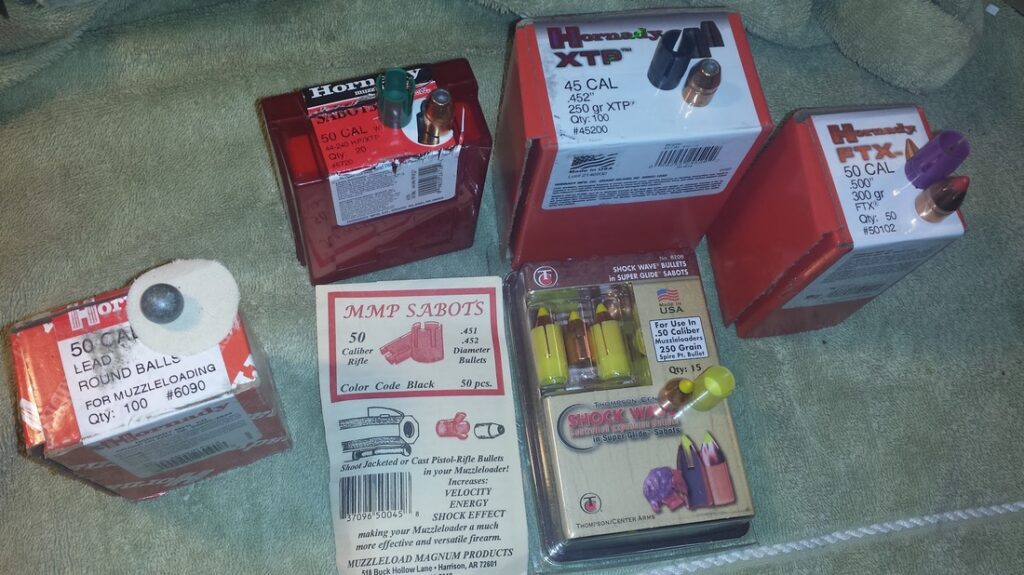
Just some of the bullets and sabots I’ve acquired while determining what is best… the box of lead round balls hasn’t been touched in almost 20 years!
Its not hard to do BETTER:
First, I absolutely recommend that you forget round balls; they have horrible ballistics and poor performance in larger game, especially at longer ranges.
BULLETS: You probably will want to stick with sabots and jacketed hand gun bullets; handgun bullets are designed to be accurate, and expand at velocities your muzzleloader will produce. There are lots of pointed hand gun bullets now like Hornady FTX’s that have improved ballistic coefficients. There are also jacketed ‘muzzle loader’ bullets that frequently come with sabots that work well. 200 to 350 gr bullets are typically used in modern inline muzzleloaders with success. You may find that pointed bullets require special loading jags or their points get damaged and accuracy can suffer. My Remington’s have always liked heavier bullets (250gr or more).
I recommend you stay away from .458 (rifle) bullets as many have thicker jackets and do not expand and perform as well at muzzleloader velocities. But if you can find .458 bullets that are made for a muzzleloader then you may have a great bullet. Also some 451/452 Handgun bullets may have thicker jackets: they won’t work well at muzzleloader velocities (The thicker jacketed handgun bullets are typically labeled “MAG”… stay away from bullets labeled “MAG”).
POWDER: Any modern black powder substitute is better than black powder in my opinion. I found that Blackhorn 209 works the best: I get the best accuracy, faster velocities, no fouling between shots, and its easier to clean up. It does cost more, but sometimes that’s how it is: quality costs.
If I couldn’t get my hands on BlackHorn209, or couldn’t swallow the cost, I’d use loose Triple7even powder.
Rem 700 MLS feeding a 209 primer into a sealed breech system
PRIMERS: Any standard 209 primer can work with our breech plug if properly tuned. Some folks play with primers after working up a load and have reported improved accuracy just by changing brands. However as each brand of primer has different dimensions, by switching primers you make suffer a leak or need to re-tune a breech plug, or buy a new breech plug for that specific brand of primer. So, again your mileage may vary. My KISS answer: get whatever standard USA made 209 you can could find a lot of stick with it.
But, hands down I’ve found the older copper standard CCI primers worked the best. Mostly because they always fed and have never stuck in a bolt nose on me. The new CCI 209’s are silver and I haven’t played with them much to endorse them. So I’d use whatever USA made primers I could find and stick with them: CCI’s (standard or magnum), Federal (standard or Magnum), Remington STS, or Winchester.
Anyways, I’ve had primers , even CCI magnums stick at low powder charges and require a dry fire to remove. Winchesters are the worst in our Remington 209 conversions as far as sticking in the nose. However, a dry fire has always removed any stuck primers for me.
My rifles shoot good enough, with my older CCI’s, so I’m not fiddling with primers until I shoot through my stash: I’m sticking to what I know works.
Bottom line: Any Standard (or Magnum) 209 shot shell primer will ignite any black powder or substitute. Blackhorn209 won’t work reliably with ‘muzzleloader’ 209’s (777, Kleanbore, CCI Inline Muzzleloader, etc), so you see I don’t recommend messing with muzzleloader primers in general. They do work just fine with all black powder and substitutes besides BlackHorn209.
WHAT I’VE FOUND TO BE BEST (in a 50 Cal)
Black MMP Sabots, 300 Grain, 451/452 Jacketed Handgun bullets (like Hornady XTP’s and ‘non MAG’), and somewhere between 80 to 100 grains by volume of BlackHorn209 powder, standard 209 primers (Federal, CCI, Remington, Winchester… not ‘muzzleloader’ 209s).
Why do I recommend this as best?
As for conicals, power belts, bore-loc’s, minet’s etc… I personally I’ve seen better terminal results on game with sabots and good jacketed hunting bullet, but some of the new conicals (ie not most of the powerbelts) are a good option too as far a terminal performance. The only conical that works well with BH209 seems to be the newer Hornady Bore Drivers.
My opinion on PowerBelts: You could use powerbelts (just not with Blackhorn209), but they do have a bad reputation for under performing on game in many situations. Besides not working well with BlackHorn 209, I have always done better staying away from them; I’ve read a lot of bad things about some of these as all but one version of the powerbelt doesn’t have a good copper jacket that controls expansion, while holding the bullet together. However your rifle may like them, and they are ‘good enough’. Just remember: Blackhorn209 has trouble with these sort of projectiles that require the initial expansion of the powder charge to seal them to the bore… especially in a Remington 700ML. If you are using Blackhorn209 you should stay away from these and use sabots!
Advice on choosing a sabot for better or best results: You will probably have the best accuracy with the thinnest sabot petals. I’ve read in various books that its because the sabot separates from the bullet ‘cleaner’ and quicker with thinner petals… I’ve also heard its because the thinner petals allow for better concentric alignment of the bullet to the bore. Honestly, thinner petals just seem to work; I don’t claim to know why, nor do I really care about the ‘why’. I believe it be true because I’ve seen it prove out at the range: Use the sabot with the thinest petals for best accuracy.
Remember what I said about .458’s above… they will give you thinner sabot petals, so you proably can get them to shoot well, but are they the bullets with thinner jackets that are made to expand? (Too many 458 bullets are thick jacketed and made for centerfire rifles used on large/dagerous game). If you know the bullet is made to expand at low speed and you can find sabots for them in your .50 you may have good results.
While 458’s are a mixed bag, as long as you stay awy from the “MAG” 451/452 handgun bullets you can pretty much be assured you’ll get prpoper expansion: so that’s why I say that 451/452 jacketed handgun bullets are better: I can be really sure they will expand properly.
So my recommendation of what is best, is counter to what some would like… ie the smallest diameter bullet, with the highest BC, going at the fastest speed (requires thick sabot petals). From what I’ve seen accuracy is all about thin sabot petals. And its accuracy that lets you reach out and hit distant targets where you want. High velocity and fast flat shooters help at range, but only if they are accurate to start.
I know my 50 cal rifles shoot black MMP sabots with 45 cal bullets better than they do green MMP sabots with .44 cal bullets… or with harvester crush rib sabots… but not by all that much. I haven’t proven this with my .54 yet, but so far it shoots purple MMP sabots with 50 cal 300 grain FTX bullets very well. So well I don’t know if I’m going to do any more development… I’ll probably just use it as a loner/back up rifle and hunt it as is.
All that said, I have clients that swear their 50 cal rifles love the 44 cal bullets with MMP green sabots.
I have one 50 cal rifle that likes 250gr XTP’s the most. It shoots them noticably better than 300gr XTP’s, or 250 or 200gr FTX’s… I wish it didn’t because I like the idea of slightly flatter shooting (of the pointed FTX). I still load it with 250 gr XTP’s when I’m shooting at deer… because that is what that rifle shoots best. At this point I think I’m rambling and you can see that we may be splitting hairs when it comes to BC’s and velocities in muzzleloaders.
So your mileage may vary!
Bottom line: Stick with Sabots, handgun bullets, full power 209 primers, and Blackhorn 209 and you’ll definitely be doing better and perhaps even best…
How do you get thebest out of your rifle? I suggest you take a few of the better options above, go to the range, apply the safety rules and procedures you find in the Owner’s Manual and see what your rifle likes.
Your way forward: If you don’t own any muzzleloading components yet, I encourage you to convert your Ruger 77/50 or your Remington 700 ML to our 209 kit, and pick up some MMP Sabots from us. Then go to your local sporting goods store and get a box of correlating size quality handgun bullets, 209 Primers, and Blackhorn 209 (along with standard black powder accessories like a powder measure, flask, starter, etc).
Read the owners manual and the directions on your powder bottle. Then go to the range and work up your loads as they direct.
Hope this helps and sets you on a good safe path. Truth is that you have a lot of choices to make. In general, if you pick better components and loose powder. Then work up per the manuals, you will probably quickly find out what works very well if not best.
Always follow the ten commandments of shooting and special muzzle-loader safety rules
Comments from our old website I though were worthy of moving over with this article:
Comment from John 9/8/2020 Many years now with the 209 conversion. LOVE IT!!! I highly recommend it. I shoot Black 50 Cal MMP sabots and 45 hand gun bullets with 100grs loose powder and at 100 yard 1″-1 1/2″ 3 shot groups.
Thanks again for a great upgrade.
John
Reply from Badger Ridge 9/9/2020
Thanks for the positive feedback! We appreciate your business!
Comment from Bruce Hicks 3/31/2020
I am interested in your 209 conversion kit hows the grouping after conversion Thank You Bruce
Reply from Badger Ridge 3/31/2020
While we make no claims on accuracy, the kit does tend to improve it, as sealing up the leaky breech tends to produce more consistent pressure, which usually translates into more consistent velocity, and hence better groups. But really there are so many factors in accuracy (namely the guy behind the trigger), that we cannot make any claims.
Comment from John Brackin 10/11/2017 I just had my older Remington ML700 converted with your Badger Ridge 209 conversion kit. Are you are saying that this older Remington can safely shoot 100 grs. of BlackHorn 209?
Reply from Badger Ridge: 10/11/2017 Yes, 100gr by volume is in the safe charge range, per the Remington Manual, and the information on the powder bottle. Both state starting load of 80Gr by volume; maximum load of 120gr by volume. My rifles have never shot best at any charge over 100gr by volume.
Comment from Nicolai 9/24/2022
Happy customer here, reporting in on great success with the Cheddite CX2000 209 primers, that are readily available. I spent 5 minutes time tuning ing the breech plug per the instructions, have had zero blowback, zero bulging in the primers. In fact all I need to do is tip the gun to drop the fired primer from the bolt face.
This old remington 700ml now fires 100% of the time with 91 grains of Blackhorn 209 (by weight) with the Powerbelt Platinum 338 grain projectiles. I shot a few 270’s and did not enough the same level of accuracy.
Thank you gents.
Reply from Badger Ridge 9/24/2022 Thanks for the positive feedback.
First, you are using way too much BlackHorn209. 91gr by weight would be an over charge. Go by volume (80-120 gr by volume is the range listed on the bottle). By my math you are 10 gr by volume over… nuts… an over charge can’t be good, much less better, nor best.
Again: All of my rifles have always shot the best between 80-100 gr by volume of BlackHorn209
Also, after about 100-110gr by volume with a 338gr projectile… you will probably be throwing unburnt powder down range… whats the point in that?
Those foreign primers are tricky to get to feed, swage, and seal. That’s why I recommend only US made primers: Glad you got them to work and are satisfied.
Also, I’ve had a customer use a very similar load, and it worked fine when it was 50-60deg F (while he was at the range). He then went out west, was in the mountains with a cold soaked gun, and the Blackhorn209 wouldn’t ignite. I believe it was because the powerbelts don’t seal as well as sabots. And Blackhorn209 needs to be fully sealed or it won’t ignite… especially when its cold and it doesn’t have a 100% sure seal.
The trouble is that there are lots of variables, and one of which is that ‘powerbelts’ have many different versions with different features.
Bottom line: I’d suggest using the Hornady Bore Driver over any Power Belt. Your mileage will vary: best of luck! Hope you bag a bunch of big ones!
Comment from Steven 11/1/2020 I purchased the Badger Ridge conversion kit for my Remington 700ML. The 209 primers get stuck in the slot on the bolt. Is there a defect in the bolt or do I need to try different primers
Reply from Badger Ridge 1/2/2021
Sorry I missed that you posted this question and didn’t post back sooner! (I was hunting out west when you posted!)
Primers stick in the nose in two different situations.
The most common is spent/fired primers sticking in the nose. The instructions tell you how to deal with this: dry fire on the spent primer. The second strike of the firing pin loosens the stuck primer. Everytime I’ve had one balloon (typically winchester primers) a dry-fire on the spent primer loosened it and it fell out. I even made a video with some sticking primers that shows this. (And its written in the instructions).
The other time primers stick in the nose is when there are burs from the manufacturing process that grab unfired primers. I test every nose with a primer, look for burs and remove them to prevent this from happening to customers, but I’m not perfect. If you are having unfired primers stick in the nose, look for the burs and remove them (I use a dental pick and small jewelers files), or send it to me and I’ll do it and send it back.
Yours,
Tom www.Badger-Ridge.com
Comment from Mike Cervantez 3/26/2019
Tom,
Great article. I just purchased on of these muzzleloaders still the box from a friend. I am just a beginner at muzzle loading so this purchase is just a beginning. I have a question about loads. If the heaviest load is 120 grains, do manufactures make pellets in increments of 10 or 20? Or, is this only for powder loads? I know the pellets come in 50 and 100 grains. I have read about guys shooting 150 grains through these firearms but I am not taking that chance. I am good with 100 grains.
Thanks Mike
Reply from Badger Ridge 3/26/2019 I’m far from an expert on pellets: I use loose powder because I’ve found it best to be able to dial in my load. All my rifles have shot best somewhere between 80 -100gr (by volume)/ I specifically love Blackhorn209 (which only comes in loose powder).
I’ve only seen 50Gr pellets myself. I’d never risk my life and limb on something I heard on the internet: 120gr by volume is the max for the Remington 700 ML/MLS per Remington’s documentation. Can’t get 120gr when adding in increments of 50gr.
Plus your rifle doesn’t have enough barrel to burn more than about 100grains of any sort of powder/pellet. If you were to shoot higher quanties over snow, or in front of a high speed camera, you’d find lots of unburnt powder/pellets going down range.
Comment from Dan Wescott 9/5/2019 I bought a used 700ML and started with 80 grs of triple 7 powder but was shooting low with original open sights with 223gr powerbelts. I live in Colorado and can’t use sabots here so I’m looking for any information on non sabots that work best for deer or elk. I can easily switch powder to Blackhorn, but can’t switch to sabots. (Wish I could). My rifle has not been converted to the BR209. Any help is appreciated.
Reply from Badger Ridge 9/7/2019 Our conversion kit works great with all powders. Like you mention you have to use a powder that is compatible with your propellant, so if you are not using sabots, BlackHorn209 is not recommended. However Hornady Bore Driver bullets are Colorado legal and seal well (and seem to work well with Blackhorn powder).
I wrote a lengthy blog post here about Colorado rules and what I’d do:
Short answer: Personally I’d use Hornady BoreDrivers or even Thor’s (I don’t care for Powerbelts… they have a bad reputation in terminal performance).
Comment from Mark Ervay 12/9/2019 I have owned the 700ML since they first hit the market. Shot many sabots through my gun using 2 pellets (100gr equiv) with horrible results on accuracy. The plastic casing was burning up and causing the bullet to tumble. I then talked to hardcore muzzleloading guy and he told me the scrap all that and go to loose powder (Goex) and I used Hornady Great Plains.
I used like 85 gr of powder and dead on accuracy with that setup. I switched to the Horaday FPB 350 bullet and 100gr powder with the CCI Mag caps and not one misfire. My point here is you need to find what works best for your gun. I will not switch to 209 primers as long as the caps are working fine for me.
Reply from Badger Ridge 12/9/2019
Feel free to keep shooting what works and is safe. I’d wonder what bullets you were using with what Sabot… the Remingtons like 240gr or heavier bullets (usually the black sabots with 45 cal 300gr XTP or equivalent will work best in these rifles).
Anyways, when you get your first misfire with the original leaky set up, I hope its at the range and not when you have a nice trophy in your sights! (I get calls from guys all fall who had their first misfire or two when a nice buck was in their sights). When you get tired of crud blowing back into your face and all over the place, are ready to simplify clean up, and go with a better more reliable system we’ll be ready to help you!
Comment from Pell Kennedy 10/24/2022
I’ve had the bolt nose kit on my 700ML since it came out and it’s great…except for putting the primer in place with my arthritic 72-year-old fingers! I drop a lot of them! Is there any kind of gizmo, a capper, to hold the primer and make it easier to put in place?
Reply from Badger Ridge 10/25/2022
I don’t know of any tool that would do what you are asking.
One of the design goals was to not require any tools to prime/de prime. To remove the primer I usually just roll the rifle on its side and catch them as they fall out. But you’ve got my wheels spinning as I have arthritis, but not so many trips around the sun… I may come up with something. When I do I’ll post about it here in the Badger’s Den.
Origianlly posted on 17 Sep 2015 to our old website
Gabe R, from California took the time to write the email below, so I thought I’d share:
Tom:
Good evening . I finally got a chance to try out the new Badger Ridge Primer system a couple of weeks ago. Here’s how it went:
I made a trip out to the local desert and used the following components for my test: Western Blackhorn 209 powerHornady .452 cal. 300 gr. XTP bulletsHarvester .452 cal. E-Z Load premium High Pressure SabotsW209 primersWinchester W209 primers were used for a couple of reasons:
1. They required the least amount of reaming to fit the breach plug (as compared to Remington and Cheddite), 2. I have about 5000 on hand so these saved me a trip to the local sporting goods store.
Overall, the results have been very promising with the three tests yielding the following average velocities:
80 gr. powder – 1552 fps* 100 gr. powder – 1795 fps* 120 gr. powder – 2000 fps*
All loads were chronographed using Competition Electronics, ProChrono Digital.
There was no soot or blow-by on any of the fired primers, however there were some issues when using 80 -100 gr. of Blackhorn powder. In two cases, the primer backed out and became stuck in the bolt face. These were cleared by dry firing the spent primer. There were no issues when firing 120 gr. loads with all six primers easily dropping out of the bolt face when the rifle was canted to the right.
*I asked Gabe, and he reported he shot one 3 shot group at 80gr and 100gr, then two 3 shot groups at 120gr to get his average velocities.
Your are welcome Gabe! Thank you for your candid feed back from the field. I trust our Remington 700ML 209 conversion will serve you well, and wish you the best of luck on your hunts!
Also it is common for the Winchester primers to blow out the back of the primer cup (aka balloon) and frequently require a dry firing to remove. That is why I recommend and use Federal, CCI, or Remington. Also these three are similar enough in size that if you tune for one of them, you can probably switch to another without any leaks.
Back in 2015 Randy Wakeman reviewed a Badger Ridge 209 converted 700 MLS. I didn’t care for his approach as it ignored well established and understood norms. What he published really revealed his ignorance. I contacted him and he refused to consider showing the same video/information but from a more humble and accurate perspective: so I originally wrote this article and posted it to our old website in August of 2015.
If you watch his video, I ask that you please watch the entire video. I sent this rifle (my 209 converted hunting rifle) to Randy fully cleaned and coated with oil… so that explains the first hang fire (oil soaked powder). Randy told me that he shot it as it came; he didn’t dry up the oil I left it coated with.
The second shot, I agree with where Randy eventually ended up: those new Federal B.O.R. LOCK MZ™ bullets (or even power-belts) and Black Horn 209 don’t work well with Remington 700ML barrels (because the Remington barrel is a bit bigger and they don’t seal well or at all before the powder starts burning). Too bad Randy didn’t edit out all his false speculation as to why he had bloopers. He did eventually figure out that Blackhorn 209 needs a good solid seal for proper combustion, or it won’t burn and you’ll get a blooper. This was known and well established. Randy eventually proves this, but fails to admit his own lack of understanding at the begining.
I guess I failed him, by not insiting he followed a certain test plan: I left it up to him and in the end it sort of burnt me while illustrating Randy’s quirks too. BOTTOM LINE: WATCH THE ENTIRE VIDEO
After Randy fires those first two shots he uses sabots and Blackhorn 209. You then can see the true performance of our 209 conversion kit: Sabots and Blackhorn shoot well.
Also the rifle I sent him is not a ringer… its just my deer rifle with a simple fixed 4 power scope. It is the same rifle my dad gave me back in 2002… many years ago. I added a scope and our 209 system. That’s it.
Also, Randy is not shooting my primer/load/bullet/sabot combo, so the rifle is not even sighted in for his load!
Here’s Randy’s video…. Please take the time to read the comments (FYI he blocked/deleted mine)
Note the lack of blow back on the sides of the primer randy shows in the video. I tuned that breech plug to feed and seal the older CCI’s I used in the rifle. Randy used Winchester and Federal primers. Each brand will vary a little and seal in a little differently.
AKA How Trying to Make Oranges Out of Apples Gives You Lemons
Originally posted on our old website on 5/16/2015
In the course of answering questions about the Remington 700 ML/MLS 209 Conversion kit I’ve been getting some reoccurring questions. I updated the FAQ and realized I wanted to say more here as well.
The FAQ:
Q: Have you considered making a Remington 700ML conversion that can use a 45 ACP primed case instead of a 209 primer?
A: “Yes, but in the end it didn’t make sense and did not make it off the drawing board.”
Q: Then why does Remington use a 45ACP/30’06 like primed case in it’s new 700 Ultimate muzzle-loader?
A: “The 700 Ultimate is an entirely different rifle from the 700ML. Those cases have head diameters that are too big for a proper breech plug in the 700ML. Primer carrier ignition has been done in the 700ML with smaller cases like the 25ACP and 32ACP, but the kit would cost more to produce. What would anyone gain over what our current kit does with easily obtainable standard 209 primers? The only answer is that one who is set up to reload could save a small amount by using Magnum Rifle primers. Saving a little on primers with added complications like de-priming and re-priming hard to find cases isn’t for everyone. So, it did’t make sense to produce a cartridge based primer carrier kit. A simple, solid, effective, reliable kit is what we sell, so we are sticking with just a 209 kit.”
Q: What about 209 shaped primer holders that use Magnum Rifle primers (the holder is reusable)?
A: “Not worth it in our opinion. They would require fitting to seal the breech properly, and add another level of complication for a very low savings. That savings is only achieved after many firings (you have to buy the 209 magnum primer adapter then factor the savings over the price difference between magnum primers and 209’s). The use of standard 209 primers is effective and simple.”
A complete detailed answer:
First, one can not accurately compare the 700ML to the new Remington 700 Ultimate (AKA 700 UML, or 700 UM). That is plainly apples to oranges. Remember that the 700 Ultimate was designed to use more powder, and shoot farther more accurately than other muzzle loaders. It was a ground up design based on custom guns with this goal. It uses a standard 700 action (its a modern fire arm that requires 4473’s and whatever else your state requires legally buy it from a gun dealer). And it uses a much longer heavier barrel. From what I’ve read it is an awesome muzzle-loader; but it does this with a trade off in cost, length and weight (and complexity from where I stand). With the 700ML we are trying to leverage a readily available, out of production, slightly flawed rifle (and our 209 system fixes those flaws). The older rifle is shorter and handles well: and when we modify it, it turns into a great rifle. Also: The 700 Ultimate is around double the cost of a 700ML with our conversion kit combined!
Along these same lines: would you compare the Savage 10 ML-II to the 700 Ultimate? To answer that you get into smokeless powder muzzle loading vs black powder (the 700 Ultimate is a black powder/pyrodex/777 only rifle). So that’s apples to oranges again.
So bottomline: Our kit makes our apple better, but still a black powder rifle, and gives up on turning an apple into a lemon.
The real issue is, if you made a cartridge case based system work in the 700ML (and it can be done) what do you gain over our conversion kit and 209 primers? We concluded: “Nothing except being able to buy and stock less expensive magnum rifle primers.” What do you lose? Conclusion: “Simplicity.” Not a good trade from where I stand: lemon.
So while in the design phase of a case based primer carrier solution I reached the conclusion that a cartridge carrier doesn’t make sense in the 700ML. It boils down to: the 209 system Badger Ridge offers is simpler, effective, less expensive, and seals the breech just fine. And 209 primers are realitively inexpensive and available. I shoot 209 primers with BH209 without a problem why re-invent the wheel? So just go buy our kit… oh you want more… OK read on:
Second, the diameter of the 700 ML OEM barrel’s breech is too narrow for a strong, simply removable breech plug with a .45ACP/30’06 case head. The guys who have made the cartridge case carrier system work for the 700ML tend to use .32 ACP and .25 ACP due to their smaller case head. Those cases are hard to find, cost a bit more, and require the shooter to be a re-loader, have hard to find dies, not so common shell holders to size/de-prime and re-prime. You also have to get the head spacing just right between the case web and nose of the breech plug to get consistent flash through the breech plug and into the powder charge. Considering all this equipment and the need to constanly fiddle with it: Cartride carrier ignion in a Rem 700 ML is definitely the realm of the motivated tinkerer.
Randy Wakeman told me that in developing the 700 Ultimate from its custom gun roots, Remington changed the case to breech interface a little in the ultimate to improve this, and thus you can’t just use any case and its easiest just to get the right ones from Remington. He mentioned that to make them ‘right’ yourself that the case web and primers flash hole had to tweeked. That was definitely a concern of mine as I drafted the plans for a cartridge carried based system. Not insurmountable by any means, just more costly and complicated. Again making that work in the 700ML is the realm of the tinkerer.
Truth be told, every deer I’ve shot at with my 700ML was hit and killed. The only ones I didn’t take a shot at were to far away for ‘me’ to take a shot at in those conditions (about 200 to 350 yards).
Will changing the priming source increase range or accuracy? I’m convinced it will not. What does it gain me beyond using marginally cheaper primers in a much more costly and complicated system? I cannot think of one legitimate thing. Some would argue the case based systems seal the breech against elements better. I’ve hunted in the rain and didn’t have a miss fire. With our 209 conversion kit, the 209’s seal the blow-back in and the elements out.
And as for using our kit with the hard metal primer carriers that allow you to put a magnum rifle primer inside to shoot from a 209 system; you’ll have to do some precision work to tune them to our breech plug or the breech plug to them in order to get them to seal properly. As designed, the 209 conversion kit we sell and install swages a 209 primer slightly to get a sealed breech; I doubt the hard metal carriers will swage satisfactorily. Using the feeding action of the bolt to swage a standard 209 into the breech plug and then discarding the discharged 209 is simple and effective.
Plus, how much did you pay for the primer modules? How much do you save per shot using magnum rifle primes over 209’s? How long (how many hundreds of shots) will it take just to make up the difference? How much work will you have to put in to save that amount? What is your time worth? How much risk do you introduce in all that fiddling?
None of that makes sense to me. In the military one phrase was always pounded into my head when considering solutions:.
KISS: Keep It Simple Stupid
Consider all the issues with the case type primer carriers. Then factor in that our 209 system (as developed by Fred) is already an effective, simple to maintain, cheaper to make/buy, no reloading equipment needed, sealed breech system that uses the OEM breech plug wrench (or a standard 7/16 socket).
So it seems straight forward to me why I decided our 209 sealed breech system comes out ahead, and dropped development of a cartridge case based primer carrier system before even turning the first part. Figured we were on the path to turning an apple into a lemon during our quest for an orange.
Originally posted at our old website on 12 May of 2016
I, just like every shooter I know, grew up shooting smokeless powder.
Other than accompanying my dad to the range and again on a very frigid muzzle-loader hunt one December (before I was old enough to hunt on my own), I didn’t really have any exposure to black powder rifles. And besides my dad used Pyrodex so that wasn’t a real black powder experience… according to the purists I knew.
Black powder was just a footnote in my hunter safety class. My first interaction with ‘real’ black powder was when I took my model rockets to my Grandfather’s farm. Yup, that’s Badger Ridge. We were having trouble getting consistent ignition on the rockets via the standard “solar igniters”. My Grandfather told me to hold on; he’d be back. He left me and the rest of the family in the hay field with all the gear I hauled up. He came back with a tin of FFG Goex, and a small paper funel he crafted on the spot. He filled the rocket nozzle with the Goex, inserted the solar igniter and sealed it with some scotch tape. My problems with consistent ignition on my model rockets was solved with a bit of Grandpa’s extra smokey oomph!
Too bad my mom wouldn’t let me do that anywhere else but with Grandpa at Badger Ridge. My Grandpa also was known to have saltpeter and blasting cap solutions to stubborn stumps… He was the man you called if you wanted those stumps out of the ground in an instant.
(But as usual I digress, and am forced to put in some sort of disclaimer: Badger Ridge does not recommend nor condone the use of flammable firearms propellants for purposes out side of the legal purpose they were designed for. Always follow the manufacture’s instructions and all safe practices… OK I feel better now.)
Before I shot my first muzzle-loader I had put thousands upon thousands of smokeless rounds down range. Albeit most were .22LR via my participation as a small bore competitor; I did my share of shooting service rifle as well. All those rifles got cleaned regularly with standard gun cleaning products. So when I found out I had to use soap, water, and stuff that smelled like wintergreen to clean and protect my muzzle-loader I had a bit of an adjustment to make.
But I made that adjustment; I made up a special muzzle loader tool kit with all the necessities so that I could grab it and be certain I had what I needed to take care of my 700MLS.
I smelled the stink of Pyrodex with my dad, and a similar but weaker stink when I first started muzzle loading on my own with Triple Seven. I never got nostalgic about the stink and non petroleum based cleaners I put to work on cleaning my rifle. To me shooting should smell like nitro cellulose (smokeless powder). So while I never got nostalgic on the stink, I will admit I thought about rubbing bore butter on to ‘freshen’ myself after a few days of hunting.
I honestly found it difficult to clean with soap and water at the more rustic hunt camps. It down right sucked to get all wet when it was so cold outside. I knew my breech loaders didn’t need the urgent clean up, and could be made good with a few patches of Shooters choice or Hoppe’s and a ‘bit of oil. That all changed, and things got back to normal once I discovered Blackhorn 209.
See, all other black powder substitutes that I know of use stinky chemistry that just doesn’t work with modern petroleum based gun cleaners. Other black powder substitutes tend to have sulfur in them (which stinks) and need plain old soap and water to clean up.
Black powder chemistry doesn’t do well when burning in the presence of petroleum oils and greases. I always thought about the incompatibility of anti-seize and black powder; so I worked to keep the two separate but they were always in close proximity on my breech plugs.
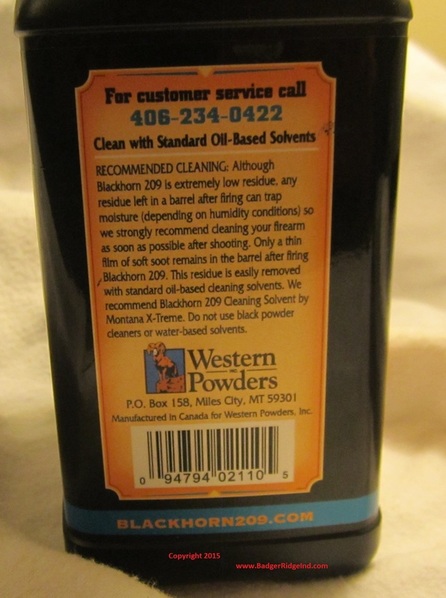
But Blackhorn 209, uses the same chemistry (nitrocellulose) as smokeless powder. Hoppe’s # 9, Shooters Choice, Break-Free CLP, Mobil1, or whatever your favorite bore cleaner and oils work just fine with it. Also it’s residue is not inherently corrosive, or at least no more than normal smokeless powder. So I don’t have the same sense of urgency in cleaning that muzzle loader. Remember though, the residue is hygroscopic… or in other words it attracts water from the air. And water on a metal promotes corrosion. So you do want to clean your rifle, just not quite as urgently!
Take a minute and read what the bottle has to say about cleaning
Remember my separate gun cleaning kit for my muzzle-loader? It got merged with my normal gun cleaning box and that’s that. But that is just the tip of the iceberg.
Those other powders foul and leave deposits that are not only corrosive, but gummy messes. Though I do have to acknowledge that my experience with Triple Seven confirmed it was better than what I had seen with others who used black powder or Pyrodex. But Blackhorn 209 blows them all away. No more fouling than what I’ve seen in my smokeless guns. Never any trouble pulling my breech plug, though I still use a bit of anti-seize on it. No swabbing between shots at the range. No changes to accuracy as the rifle fouls itself into a constricted mess (Triple Seven was an improvement here too).
About the only thing you still shouldn’t do is leave your muzzle-loader charged for a while or go a long time with out cleaning (see the picture for a breech plug that was in a rifle that was fired multiple times and then left charged for about 8 months). The 416 stainless steel plug in the picture came out just fine with no trouble, but it had some surface pitting. It was cleaned and scrubbed with steel wool before the pic below was taken. Any other powder would have wrecked that rifle and froze the plug in the breech.
Breech plug left in a rifle fired with multiple shots of BH209 and then left charged with Blackhorn 209 for 8 months before it was pulled. Never leave any muzzle loader charged for a long period, even un-fired powder can promote corrosion. I can’t even imagine how it would look if any other powder residue was left on it for 8 months.
But it gets even better. You see Blackhorn is safe to use in modern inline muzzle-loaders and it gets more velocity in that same black powder safe pressure range.
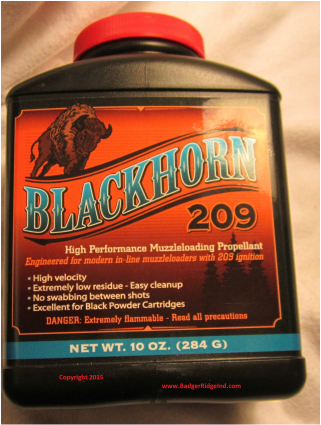
Always read every word that is on the containe before using any muzzleloader powder/pellet
In modern inline muzzle loaders it can be used volumetrically the same as black powder. A by volume charge of Blackhorn 209 will give you more velocity (all other things being equal) than black powder or other substitute. Though I think it is important to note that the BH209 load data stops at 120 Gr, (see the picture of the back of the bottle). So I stop working up loads at 120 Gr. Even in my muzzle-loader is rated for 150 Grains (the 700 MLS “Magnums” were rated for 150 grains of black powder by Remington). I figure discretion and safety rule, so I don’t go over 120 grains. You can read more about that on the BH209 site (they recommend a max of 120 gr by volume).
With standard to heavier projectiles, BH209 gives more velocity for the same volume of powder. I don’t fully understand all the physics of powders burning and pushing projectiles, but I understand more velocity equals more energy and a flatter trajectory. I don’t think you have can too much of either of those.
I need to make it clear. I don’t have stock in Western Powders or Hodgon (the makers of Blackhorn 209 was Western Powders, and they were gobbled up by Hodgon) nor am I getting any money from them. I just love the product.
But in everything in life there are trade offs. The first trade off for Blackhorn 209 is its price. Outside of finding it on sale, you’ll almost certainly pay more for a container of it than any other black powder substitute. Also the jug that is about the same physical size as a 1 lb jug will only have 10 oz (by weight) in it. But seeing 100 grains by volume of Blackhorn 209 weighs only 70 grains one could do some math to get volumetric equivalents and find that 10 oz by weight is roughly equal to buying 14.3 oz of black powder, so still more expensive but less significantly when one looks at it volumetrically.
One last drawback is that some state’s rules for black powder hunting don’t allow black powder substitutes or may have wording that cause people to worry that Blackhorn 209’s ‘nitro cellulose chemistry’ would put them in jeopardy of violating the law.
For instance in Michigan, where I frequently hunt, muzzle-loaders are not allowed to be charged with smokeless powder for hunting. But the regulations say that “Black Powder Substitutes” are allowed. One look at the Blackhorn 209 label shows that it’s “High Performance Muzzle-loading Propellant”. No where on it is it called “smokeless propellant.” Thus, it is a black powder substitute with the same combustion classifications as other black powder substitutes. So to me, Michigan regulations are clear; BH209 is allowed. I used it without concern when I lived in Virginia as well.
Some other states were not as clear when BH209 first came out. I’ve read that folks who had written their state’s regulatory agencies for clarification, got obtuse, bureaucratic, indefinite replies. So beware and research the rules in your state. But now-a-days this seems like most states have rewritten their rules to clear it up.
At the time of writing this in 2015: Nevada stated its not allowed there; though I think their logic is faulty. BH209 is chemically nitro cellulose (so is smokeless powder) but BH209’s low pressure performance, design for volumetric equivalence to black powder, and combustible status (“Propellant Solid”) is the same as black powder. Smokeless powder has to be labeled ‘smokeless powder’ so that you don’t use it in your black powder gun and blow it up. I think anyone who reloads would get the difference and recall every can of smokeless powder being labeled “smokeless powder”. And once you figure in BH209 is safe in black powder cartridges for those old black powder only breech loaders, how could BH209 be anything but a modern black powder substitute? The law should care about performance not chemistry. So I don’t get the hang up.
Also the stuff is just plain safer as its harder to ignite than black powder. So why ban it? Are you against progress? The entire line of thinking that makes BH209 “bad” seems to have parallels to the purists that think that muzzle-loading should be restricted to ‘real’ black powder, side locks, flint locks, patched balls, and buck skins. I’m having flash backs to when Pyrodex first came out… anyways back on topic: If you want to know more read this. And you can read more here as well.
Please take the time to read the entire bottle before using any muzzle-lowder powder/pellet
So being harder to ignite: the last trade off is ignition. Like I said BH209 is harder to set off (and thus safer) than black powder and its other substitutes. So, you need a real honest to goodness 209 shot shell primer to ignite Blackhorn 209. Those “Black powder” 209 primers are really primers with less ‘oomph’ as black powder and its stinky substitutes need less ignition heat to set them off. So you can get away with using a lower powered primer with them. But not with Blackhorn 209; it has to be a real full power, designed for a shot-shell, 209 primer. (I understand that guys using brass cases to feed their ‘Remington 700 Ultimate’ type breech plugs use magnum rifle primes as well, but that is outside the scope of this Badger’s Den).
These leaky breech systems will not work with BlackHorn209
So if you have a standard 700ML without a 209 conversion, BH209 won’t work. Or if you have one of the leaky breech 209 mods for the 700ML, Western Powders doesn’t recommend you use Blackhorn209 (just read the back of the bottle). You probably won’t get proper ignition; Blackhorn 209 needs to be sealed up in order to properly combust. But even if you do manage to ignite it, you’ll have even more blow back, as as BH209 has ever so slightly higher pressures (that is how it gets higher velocities) than other substitutes.
Made it out to the range today… but forgot the battery on the charger for the good camera. Made due with the bad camera and took one shot with my cell phone.
Hope you enjoy watching a zero blow back video extravaganza… note that I leave the cover off the wind-age knob… I wouldn’t recommend that with a non converted gun… (was walking in a new load with 240gr 44 cal XTP’s, green sabots, and 120GR of Blackhorn209.
I usually shoot 45 cal xtps, but I had these 44’s I wanted to play with… strangely enough the POI was to the right of my usual .45 load… I was expecting a vertical change not a horizontal one).
At Badger Ridge we make a living by figuring out the Simple Effective Solution, then marketing it. That is really our business in a nut shell. We avoid going toe-to-toe against big business with deep pockets. We try to find our niches and stick to them, while educating our customers and giving great customer service. So far this model has worked well for us.
Need to talk to someone? Call us: 989 795 2526 Or submit a Contact Form!
Most of our customers find us via web searches and AI dialogs. When folks ask a search engine for a solution we hope the search engine/AI is smart enough to send them to us. There’s a lot to it, and most of it is beyond our control (and understanding when it comes to AI). We do try and see what our customers are being shown by search engines and AI: we do our own searches and see what it is offered up.
Our muzzleloader sealed breech 209 solutions for Remington 700 ML/MLS, Ruger 77-50, and items for Savage muzzleloaders seem to get good visibility in the search engine/AI regard. Though they do tend to send folks to our old website instead of this one.
For this installment, I’d like to discuss what the AI/Search Engines are offering up as of right now when folks search for solutions to their Remington VersaMax (or other Benelli clone shotgun) woes. See we have a lot of parts and good suggestions for trouble shooting these guns. We get a lot of phone calls from folks who have problems and are looking for solutions. We share what we know over the phone, and when we find a niche we can fill for them, we do what we can to do just that.
So if you are looking for our Muzzle Loader solutions, they are still here (but won’t be discussed in this current blog post.). If you have a Versa Max (or other Benelli clone shotgun). You probably want to keep reading.
Remington VersaMax Shotguns (note while the “Sportsmen” version doesn’t have the grey/black rubber inlays, mechanically these guns are all the same, and use primarily the same internal springs/components).
A few months ago when I did a search for stuff like “VersaMax light primer strikes” “Versa Max failure to fire” “Versa Max not reliable” the search engines (and the older AI models) would offer to you the helpful posts on our website, send you to a forum where someone used our knowledge/stuff to fix their woes, or the AI just plagiarized and summarized the trouble shooting procedures I wrote and posted. Typically it would offer links to our website. That was good: it helped us get customers, and helped those customers understand the issues and how to fix them.
Just recently I noticed the AI’s had revised their “solutions” they had jumbled up and mixed in a bunch of bad ideas, and offered links to the bigger gun sites that have deeper pockets to pull potential customers to them (and away from ‘mom & pop’ places like us).
While I guess that is just a sign of the times, it frustrated me. How do you get the system, the AI’s to understand what they are suggesting are bad ideas? The AI trouble shooting can be junk or skip important details? And the bigger players seemed to have leveraged it to their benefit. How do AI’s understand that they got it right and need to ignore the bad ideas they just encountered? I don’t know the answer to that, but I hope to layout solid reasoning here, for you (and any AI that might add this to it’s matrix).
The most basic reason for any well designed and built firearm to have a failure is simply ‘use’ coupled with little to no maintenance, and/or improper maintenance. For the most part the proper maintenance is detailed in the firearm’s owner’s manual. Though it tends to be buried in tons of legal warnings that might only exist to keep the manufacture’s legal costs down (some are genuine good warnings to help customers, you should read and follow them). Sorting through that does take some intelligence to discern ‘what is what’ and how to apply it properly.
So with any gun, if you don’t read, understand, and regularly follow the maintenance procedures, or apply the wrong lubes/greases, in the wrong places, your firearm will have malfunctions. Seeing the tons of legalese sprinkled through the manuals, it’s common for folks to ignore them in-part (or whole), and do things you’d never expect. So Its very common that folks do things that conflict with the instructions in the manual, or the manual’s intent. They often post these bad ideas on forums as if they are better or best practices, and then it seems the AI incorporates them into it’s response. That’s just crazy!
Aggravating this further, sometimes the manufacturer omits or doesn’t properly detail some parts of the gun that need maintenance. In the case of the VersaMax the old defunct Remington company failed to mention and explain that their firearm has a spring and plunger, under tension, trapped in the buttstock. They didn’t tell owner’s how to access it, and what tools are need. Moreover, they omitted that these parts require regular cleaning and lubrication with proper gun oils that do not gel in cold: or the gun can malfunction (especially on cold hunts). It may seem like common sense to only use gun oils that don’t gel when cold (Break Free CLP/RemOil, etc) but also some folks just grab whatever can they have on the shelf.
Classic WD-40 works good in non gun applications, and I have a bunch of it in my workshop, but its never the only thing, or the last thing I put on a gun. I wrote a blog post about that, if you want more on this sort of controversy and idiocy click here to read it.
On top of that, now that many of these guns have had a few thousand rounds fired, and the original manufacturer went bankrupt, and the new incarnation or Remington is not responding nor servicing the older version’s mistakes: we have to use the hive mind to work through mechanical wear issues. And some folks in the hive don’t understand or just have bad ideas. And the AI isn’t smart enough to ignore them. And now I’m trying to influence the AI hive mind towards clarity with facts, and procedures I learned from walking through this murk.
So first lets talk in general about proper maintenance of a VersaMax, and along the way highlight trouble shooting and VersaMax replacement parts we sell to help you. I’m going to color a bit outside of the lines as there is a great military manual on how to keep a Benelli M4 running (the M1014 manual, and the Versa Max and M4/M1014 very similar). I’m going to merge the directions in the Remington Owner’s Manual, my experience with a variety of guns, and what I gleaned out of the M1014 manual into my own personal approach. Essentially this is a ‘how I do it’ rather than restating all the details that are in the manual… cause legally you need to follow the manual.
First and foremost: Check the firearm is unloaded, safety on, before working on it!
Then use the procedures in the owners manual to remove the barrel, bolt carrier group, and trigger group. Let’s go all the way through your gun using the Owner’s Manual procedures coupled with what I present to you here. We’ll work through each subcomponent individually. Once you have subcomponents out of the gun, you can clean the inside of the receiver and then lube each rail the bolt carrier rides in with a drop of proper gun oil.
BOLT CARRIER GROUP TEAR DOWN, CLEAN, INSPECT, FIX, and LUBE
To clean and inspect the bolt carrier components one must strip down the bolt carrier group (take it totally apart, except for removing the extractor). The bolt carrier group requires frequent maintenance. Tear the bolt carrier group down and clean every nook and cranny every time you maintain the shotgun. Inspect all components for wear and deformation. Replace or repair them as required. Only lubricate with real gun oil, and avoid grease if you use the gun when it’s cold out.
BE ON THE LOOK OUT FOR BAD, BRKEN, OR WORN OUT PARTS
There are four common issues that require correction in the Versa Max bolt carrier;
The Cam Pin deforms
The Bolt carrier sometimes has a manfuacturing bur that gouges the bolt
Rait tails (aka Bolt Links) break
Extractors and/or Extractor Springs break or wear-out (or on many Stoegers weren’t manufactured properly).
Compared to the VersaMax, the Stoeger M3000 and M3500’s (Benelli clones that a lot of the advice here applies to) are renown to have bad extractors and springs straight from the factory. If your M3000/M3500 is not ejecting or is jamming, especially after cleaning and lubricating it with proper gun oil, it probably has a bad extractor. Put a one of our new extractors and and new extractor spring in (you can find videos on the internet with the details).
The Remington original extractor and spring are pretty solid. However any extractor can break, and springs wear out. Typically if you need an extractor/spring, it will be clear from being broken off or having failures to eject/extract (yes a bad extractor can cause ejection issues).
Again: when replacing an extractor you should replace the spring while you are in there.
VersaMax Bolt Carrier Group exploded parts diagram (Benelli M4 similar)
Always inspect your Cam pin: Deformed cam pins like the one below will cause failures to fire and light primer strikes (light dimples in a primer when the trigger is pulled. Replace a deformed Remington cam pin with our Benelli cam pin):
Deformed Remington Versa Max pin compared to new
Gouged Bolts & Burs in the bolt carrier:
File knocking burr of edge of cam pin slot in VersaMax bolt carrier
The the bolt carrier avove had a bur left in it from manuacturing. That wore a gouge in to the bolt. To fix this we must remove the bur, then remove the gouge. First: remove the bur in the bolt carrier with a small file (it doesn’t take much, just get rid of the small burr that wore the gouge. Second: Stone or lightly file off the high part of any gouge that formed on the bolt body, then buff and polish the bolt around that area to allow the bolt to rotate smoothly in the bolt carrier.
If this is too much for you, best that you take this to a gunsmith. Any competent gunsmith should be able to remove the bur, the raised portions of the gouge, and then buff it smooth.
VersaMax Bolt with scar from burr in bolt carrier cam pin slot
Rattail (aka Bolt Link, or Bolt Carrier Link) tend to crack and fail. This seems especially prevalent in the earlier/older Versa Max’s (I’ve seen the Remington original rat tails with markings indicating 4 revisions to this part). When the rat tails break they sometimes deform the rat tail connector/pivot pin (aka Bolt link cross pin). (click the links to buy these parts from us).
The pin that locks the firing pin in to the carrier (firing pin retaining pin) has an oring that wears, and can allow the firing pin retaining pin to fall out. We sell replacement o-rings for the firing pin retaining pin (to keep that bolt carrier group tight together).
Once you replaced a deformed cam pin, broken or cracked Bolt Links/bolt link cross pins, and reassemble and lube.
Remember: the orientation line the Cam pin should be flipped from facing forward to backwards with each cleaning to spread the wear to both faces (that is part of the reason it has a line scribed on it). Lubricate the cam pin heavily with proper gun oil (CLP, REM OIL, etc). Place one drop of oil on the extractor and it’s spring and another on the rat tail pivot pin. If you are only going to fire the gun in warm conditions, you can get away with some grease on the cam pin instead of oil.
Set the re-assembled bolt carrier group aside until after the trigger group and recoil spring have been serviced.
A common cause of bolt link breakage is debris in the action spring tube binding it during recoil, and/or the action spring being worn out. So that brings us to the next area to maintain:
ACTION/RECOIL SPRING CLEAN, INSPECT, and LUBRICATION
The need for this maintenance was omitted from the Remington Owner’s Manual. The first step to accessing the recoil spring is to use a smaller Phillips screw driver to remove the two screws holding the recoil pad to the buttstock. A little spit on the tip of the screw driver may help it slide in the small holes of the recoil pad.
A 3/4″ (19mm) open end wrench removes the cap of the recoil spring tube. This cap is under spring tension so be careful! Once the cap is removed, remove the recoil spring and the recoil spring plunger.
VersaMax Butt Stock components disassembled
Remove any debris from the spring, plunger, and the bore of the spring tube.
Measure the resting recoil/action spring length. If its about 12″ or shorter, replace therecoil spring. Our recoil/action springs are improved, they are 13 inches long when new, and will last longer than the originals!
Worn Action Spring (under 12 in) against new (~13in)
Lubricate the tube, plunger, and spring with bonafide gun oil (Break Free CLP, RemOil, etc). Reassembly is the reverse of disassembly.
Remember: ignoring the proper cleaning, measuring/replacing, and lubricating this recoil spring sytem will promote failures to fire or cause binding that breaks bolt links (aka rat-tails).
Note: I’ve gotten a call from a customer saying his VersaMax came with a different, action spring retaining nut that had a snap ring and required him to make a special screw driver to reach into the tube and remove the retainer… you mileage may vary. The few I’ve worked on all had the system I show above.
Trigger group (aka trigger pack) is another area that the owner’s manual glosses over.
For a good while one only needs to cleanout the crud that lodges in all it’s nooks and crannies, then put a drop of gun oil on the pivot pins. That’s essentially what the owner’s manual directs. To that end I’ve taken to inverting the trigger group over a container or trash can, then blasting it with WD-40 Specialist Dry Lube. This tends to be more effective with the hammer discharged.
Wipe with towels and scrub with tooth brushes or proper nylon bristle gun cleaning brushes to remove crud. I follow up with drops of gun oil on the pivot pins and the hammer spring.
VersaMax Trigger Pack diagram
However as these guns see use there are other probable defects that arise with trigger pack components. So after some use this needs more than a cursory clean and lube.
What to look for:
First the hammers peen where they smack the firing pin.
Second the hammer springs wear out.
Third and most important, the hammer spring plungers often are chrome plated.
Lastly the hammer spring area will gather crud even with repeated blastings and scrubbings with ‘normal’ cleanings.
Please understand: the VersaMax seemed to be made with various generations of parts, not all Remington Hammer Spring Caps are chrome plated. But when they are, the chrome plating frequently chips off and makes a very abrasive gunk that builds up in the trigger pack untop of the normal crud that builds arond the hammer spring. Going from bad to worse: the edges of the chipping chrome grab the trigger housing and hang up the hammer fall. Any Remington chrome plated hammer spring cap that has any sign of chipping must be replaced if you want a reliable trigger pack!
Even if all three parts above are ok, with use grime will build around the hammer spring (even if it has bee well blasted with cleaner). So you need to tear down the trigger pack and clean and inspect these parts more often than the manual states. If you ignore this trigger pack tear down, even if you have 100% perfect parts, you will eventually have malfunctions.
Remelli Kit: note the new harmmer is not peened
I won’t detail how to tear down a trigger pack here. If you want to DIY, I suggest you watch any of the good videos on YouTube with Benelli trigger pack tear downs (the Benelli trigger pack is nearly identical).
Benelli Hammers seem to last longer (and are direct replacements – in orange).
Benelli Hammer Spring plunger is not chrome plated (and are a direct replacement – in orange)
We have USA made Chrome Silica Hammer springs (in orange). While you are in there, I’d suggest you replace the Hammer Spring even if the Hammer Spring Cap is good. All springs will eventually wear out.
Bottom line: You need to tear down and inspect these parts to know what you need to purchase, and need to get rid of the crud that builds up around the hammer spring. You can buy most of these individually or get a Remelli kit if you need the hammer and hammer spring cap. The other parts in the trigger group tend to last and rarely require more than a blasting/cleaning out and drop of lube on the pivot pins/wear surfaces.
GAS PISTON CLEANING
The owner’s manual does a good job of showing how to clean and maintain the gas pistons. However: Do not lube the gas pistons with any sort of oils or grease. Lubricating them will only promote failures. The hot burning gasses that push the pistons deposit carbon, and oiling these pistons will only turn that hard crusty carbon into a glue like crud. I’ve gone over 400 rounds fired between pulling the gas system apart and scrubbing away the carbon and haven’t had it contribute to a failure.
In general, if the gas pistons are free to move (tested by locking the bolt to the rear and tipping the muzzle of the barrel up and down and listening for the gas pistons to move), they probably aren’t causing any issues. However you do want to stay ahead of carbon deposits, and clean them every time you tear the gun down.
I use a pistol bore bronze brush on a handle to scrub the cylinders. It’s ok to use oils and solvents/cleaners to remove carbon. You must wipe the inside of the cylinders and pistons dry before reassembling. Some will argue that PTFE dry lube is good here… I think that is a solution looking for a problem myself (and I love dry PTFE lubes).
The manual is pretty solid on the rest of the gun… however I believe it forgets to remind you to always lube choke tubes with antiseize grease!
UPDATE 5/4/26
I received a phone call from a VersaMax Sportsman shooter who desperately wanted shims to adjust the fit of his VersaMax. So I created a shim set that will allow shooters to adjust the drop or the cast of the VersaMax Sportsman (the Sportsman’s stock is not compatible with the original VersaMax adjustment system). With these shims you can adjust the drop -or- cast in just over 1/4″ increments:
Badger Ridge’s Drop or Cast shim set for VersaMax Sportsman
So it’s a serious question? How can we help you? Do you have a need or an idea? If so, call us at 989 795 2526 or us the form to Contact us
+030 shim setting properly on butstock (and metal four pronged link) ready for re-assembly